What is GDP?
-
Wendell Brock
- Apr 10, 2023
- 2 min read
It’s hard to come across an economic report that doesn’t mention GDP. As far as financial or economic acronyms GDP, Gross Domestic Product, is probably one of the most used and recognized. Most people have at least a superficial understanding of what GDP is, but in the spirit of Financial Literacy Month, I’d like to delve a little deeper, and perhaps shed some light as to why this is such an important and commonly used gauge.
Gross Domestic Product is a limited measure of the U.S. economy. GDP tracks the value of the final goods and services that are produced in a country in a given year (this does not include items purchased in making a final product, hence the limitation). Changes in GDP are an indicator of the nation’s overall economic health. This is important because it provides insight about the size and overall performance of the economy. Like an electric meter measures the amount of energy a building uses, GDP measures the annual money flowing through the economy. Simply put, an increase in real GDP is a sign that the economy is doing well.
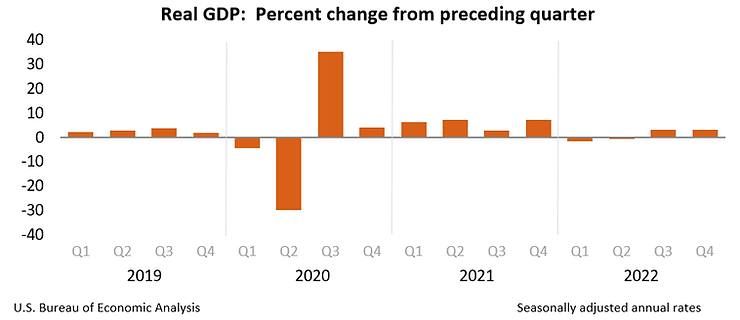
The government collects and compiles data through the Bureau of Labor Statistics (BLS). The data is collected through other federal agencies, such as the Census Bureau, the Bureau of Labor Statistics, and the Treasury. A new GDP report is released 4 times a year.
Because GDP is collected at current prices, it would not be accurate to compare data from two periods without making adjustments for inflation. In order to determine “real” GDP, prices have to be adjusted to account for the change, otherwise there would be no way to tell if the value of output has gone up because more is being produced or just because prices have increased. Another statistical tool is used to eliminate the effects of inflation to give real GDP, this is the version we need to look at.
The purpose of measuring GDP is to provide data about how fast the economy is growing, to see the spending patterns on goods and services, what percent of the increase in production is a result of inflation, as well as other economic factors.
It is also important to know what GDP is not. GDP is not a measure of the overall well-being or standard of living within a country. Although it is frequently assumed that a healthy economy equates to a higher standard of living, GDP does not capture many of the things that truly indicate well-being, since those things do not involve any transactions.
GDP is a specialized tool, which can be useful when used in its proper scope. GDP can help economists to see historical trends, make projections about the economic future, and compare our economy with other nations’. Understanding GDP can help support investment decisions and provide insight to our current economy.