Outside Economics

Alzheimer's in the United States

Posted by Wendell Brock on Tue, Mar 15, 2022

Alzheimer's in the United States

  • Wendell Brock
  • Mar 15, 2022
  • 2 min read

Alzheimer’s disease, the most common cause of dementia, is a brain disorder that slowly destroys memory, thinking, and behavior. It is named after Dr. Alois Alzheimer because he discovered abnormalities in the brain of a 50 year old woman he had been observing. Her symptoms had included memory loss, language problems, and unpredictable behavior. After she died, he examined her brain and noted distinctive plaques and neurofibrillary tangles. Dr. Alzheimer called it "a peculiar, severe disease process of the cerebral cortex".

These plaques and tangles in the brain are still considered the predominant markers of Alzheimer’s disease. Another notable characteristic is the loss of connections between nerve cells (neurons) in the brain. Neurons transmit messages between different parts of the brain to the rest of the body. These initial changes and resulting damage takes place in areas of the brain involved in memory, resulting in the early symptoms most people associate with the disease, including difficulty remembering, poor judgment, repeating questions, wandering or getting lost, or losing or misplacing items in odd places.



As the disease progresses it begins to affect areas in the cerebral cortex, resulting in the change of language, reasoning, and social behavior. Eventually, many other areas of the brain are damaged. This tends to be when caregivers notice additional symptoms like excessive worrying or aggression.

Because Alzheimer’s is a progressive disease the early stages of memory loss are mild, but in time individuals lose the ability to carry a conversation, respond to their environment, complete simple tasks, and are no longer able to meet their own personal needs. On average, once a person is diagnosed with Alzheimer’s they will live between 4 to 8 years, but could continue to live for as long as 20 years. Alzheimer's disease accounts for 60-80% of dementia cases in the United States.


Recent research has shown that people with Type 2 diabetes have a higher risk of Alzheimer’s. The correlation between Type 2 diabetes and the brain’s inability to respond to insulin, negatively impacting memory and learning, has led researchers to call Alzheimer’s Type 3 diabetes.


• 1-in-9 Americans over 65 have Alzheimer’s disease.

• One-third of Americans over age 85 are afflicted with the illness.

• Caring for a victim of Alzheimer's Disease at home can cost a family up to $22,000 per year.

• In 2014, more than 15 million Americans provided more than 17.9 billion hours of unpaid care for people with Alzheimer’s disease and other dementias.

• In 2014, Alzheimer’s and dementia caregivers had $9.7 billion in additional health care costs of their own.

• People with Alzheimer’s disease are hospitalized three times more often than seniors without Alzheimer’s.



The Insidious Tax: Inflation

Posted by Wendell Brock on Tue, Mar 08, 2022

The Insidious Tax: Inflation

  • Wendell Brock
  • Mar 8, 2022
  • 3 min read

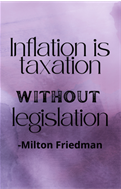
Someone once said, “Inflation means that your money won’t buy as much today as it did when you didn’t have any.” We may chuckle at this, but inflation is no laughing matter. Some people even think that a small amount of inflation is good, showing that demand is slightly higher than supply, indicating that the economy is growing.


By definition inflation is an increase in the price of a good or service without any corresponding increase in the quality of the good or service. In other words, you pay more money for the exact same item. I’m sure everyone has noticed the jump in prices at the grocery store and the gas pump, as well as in housing, cars, and even utilities, with electricity prices surging 4.2 percent in January alone. Inflation has risen 7.5 percent in the last year, which is the biggest spike since 1982.


As a teenager/young adult, I remember well the inflation of the 1970’s and early 1980’s. At that time housing was going through the roof in Los Angeles, where I was raised. Proposition 13 was put on the ballot to roll back property taxes and limit their increases, because property taxes had inflated so much due to the massive increase in home values.

During this same time period gas went up from about $0.36 per gallon in 1972 to over a dollar, around $1.19 per gallon in 1980. I did a lot of homework for my high school classes while sitting in gas lines on the odd numbered days of the month. Now we have a return to the highest inflation in the last 40 years.


Inflation is a regressive tax, meaning it is applied uniformly, taking a larger percentage from low-income earners than from high-income earners. This results in a heavier impact on people with lower-incomes or that are higher-consumers. This recent, steady rise in prices has left many Americans less able to afford food, gas, and other necessities.

It’s a bit like high blood pressure, known as the silent killer. It usually increases in such small amounts that a person doesn’t notice it, not until they look back and see how much it has increased over 20 or 30 years. Twenty years at two percent is a forty percent increase (not including compounding). It’s the large increases within a year that catches the attention. We all know what it does at the gas pump, here is how it works with investments.


Let’s say that your rate of return on an investment is 10 percent, and you are in a 24 percent tax bracket-how much of your 10 percent return vaporizes into taxes? Twenty-four percent of it. That leaves you with a 7.6 percent return. Now let’s say we have a five percent inflation rate. Your 7.6 percent return now becomes a 2.6 percent return, because five percent of it vanishes due to inflation. Do you see what just happened? You lost 74 percent of your anticipated return to taxes and inflation. In other words, if you are in a 24 percent tax bracket and inflation is at five percent, it’s like being in a 74 percent tax bracket. Your real return-after taxes, after inflation-is 74 percent less. Five percent inflation destroyed as much of your return as a 50 percent tax rate.


In spite of the dark shadow cast by inflation, there are ways to plan and protect your finances. You can establish a plan to overcome many obstacles created by inflation. Minimizing personal spending and creating a budget (and sticking to it) can create a cushion of security. Reducing housing costs by trading in a large home for a smaller one can reduce monthly outflow for items most subject to inflation: property taxes, utilities, insurance, and maintenance. Another tactic could be to add investments to your portfolio that are more likely to increase in value as inflation rises, while at the same time, balancing stock investments with conservative options to maintain stable returns. Above all, remember it’s how much you keep that matters most.


Does Bigger Government Equal a Weaker Economy?

Posted by Wendell Brock on Thu, Mar 03, 2022

Does Bigger Government Equal a Weaker Economy?

  • Wendell Brock
  • Mar 3, 2022
  • 3 min read

Since the pandemic erupted onto the scene back in 2020 government spending has again been on the rise, and so has their role in our day to day lives. The Federal Reserve (the Fed) is starting to reduce its holding of mortgages and Treasury securities. The Fed grew the money supply in 2020 by 26 percent, in 2021 they grew it by five percent. We are starting to experience the effects of this inflation.

With mounting regulatory burdens, higher taxes, out of control government spending, and all the new mandates, the government seems to have become the leading lady in our own individual stories. There are those that are determined to push Washington back to its pre-pandemic role. “Government, to me, should be in a supporting role, not a leading role; a watchdog, not a cow to be milked,” said Sen. John Barrasso (R-Wyo.). “The goal is to help people get back on their feet but not to make this the new normal.”

A survey done by Gallup in 2021 found that more and more Americans have shifted back to favoring a less-interfering approach when the government is addressing the nation’s problems.

In another survey Gallup found that at least half of Americans since 2005 have said that the government has too much power, peaking at 60% in 2013 and 2015.

So what does this all mean for our economy? There have been many academic studies which have shown an inverse relationship between the size of government and economic growth. For example, the economy of the U.S. used to grow at an annual rate of 3%, but the average rate has dropped to 2% in the last two decades, while government’s spending has increased. Since the terrorist attacks in 2001 big government got even bigger and has continued to enlarge its role ever since.

Government spending has increased from 35 percent to nearly 44 percent of the GDP over the last 25 years. While the National Debt has grown to 128.1 percent of GDP. Milton Friedman once said, “The thing you should keep your eye on is what government spends, because that’s the true tax.”

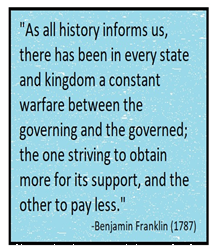
In other words, if the government is spending half of what our country is producing, that’s half the money out of our pockets, which leaves us only half free. In the big picture, it's not always the deficit that is the critical variable, the key thing to note is how the government is financed. The government is clearly taking on more debt than is logical in any circumstance.

A healthy economy does need some government to enforce appropriate regulations, but where is the line? How much is too much? Most economists would agree that there are always circumstances when higher levels of government spending would have a positive impact. More often than not, real economic growth happens with less government interference, and more freedom to the people, and business owners.


There is always a price to be paid when government spending gets out of control. That price is paid out of the pockets of the citizens and the economy slows down. According to The Heritage Foundation, there is overwhelming evidence that shows when government spending is too high, America’s economy slows.

Growth happens when we the people, and businesses, keep more of our income. That is why tax planning is so important. The more you are able to keep, save, invest, and spend yourself, the more the economy grows!

For example, in a business sense, if a business saves 10 percent in taxes, on $1.0 million in profit, that extra $100,000 could be used to pay for additional growth opportunities, hiring employees or increasing wages, new machinery, or other opportunities to help the business thrive.


A healthy economy, generally grows north of three percent, less than that and it is more of an anemic economy. Our current economy is anemic! We need less government, so we can grow and prosper. How we achieve this, I am not sure, as it seems most of our elected officials continue to vote against the people. With all that is happening, perhaps the best thing we can do is hold our elected servants responsible for the job they are doing, and remember to save first and spend what is left over!


The Yestion Mark™

Posted by Wendell Brock on Wed, Mar 02, 2022

The Yestion Mark™

  • Wendell Brock
  • Mar 2, 2022
  • 2 min read


Most of you know me, as I have either worked with you for many years, or a few months, I have been in some aspect of the financial industry since 1987. Though based in McKinney, Texas, I am able to help clients all over the country.

Years ago, I was meeting with an easy-going couple. They asked me a question that could have been answered with either a “yes” or a “no.” Being a little silly, I answered, “Yes, you can’t.” We got a chuckle from my oxymoronic answer, as we addressed their needs. Explaining my answer helped them understand that depending on their choices and overall goals, they could choose either strategy. They could proceed with the “yes” strategy, but it would take them down a road that wasn’t advisable. The “no” answer would give them a more positive solution.

Since that conversation I have given that answer, or one similar, to thousands of different questions people have asked. “Yes, you could proceed, but it may lead to an unsound position and might not have the best results.” Or perhaps, “yes, you could make that choice, but there could be something better.” It seems we always have choices.

Some time later I was meeting with a good friend of mine to discuss some marketing ideas. I was trying to come up with a logo that would represent the foundational ideals of my business. One important thing that I have always believed in is the ability to act, do something, or make progress towards a goal.

Being that I am, what I would say, a realistically positive person, I really do like to tell people, “Yes you can do this!” Why not develop a mark or symbol that represents a “YES” answer? Our discussion led to creating something similar to the

exclamation point, hence the Y with a dot under it. It was during this brainstorming session we developed what we named a Yestion Mark™.

The dot represents each of us on a path, and just like in the Y, our path will diverge with choices we encounter on a daily basis. Some of those choices can seem small and insignificant, while others may seem big. It’s times like these that we all need more encouragement and support. The Yestion Mark means, “YES! You can do this; YES! You can accomplish your goals!”

Part of my mission as a financial advisor has always been to help people make choices that will solidify their future in an uncertain world. To do that I advise my clients to make choices that Yield a Secure Tomorrow.

It's not always easy to Secure Tomorrow. Thankfully, we as people are able to do hard things, it's in our nature. That’s how we grow. I love assisting people with this growth process. At the start of a new year, as we all look to improve our current circumstances, when questions arise, remember I am here to help!


120514_WWBrock_1

Wendell W. Brock, MBA, ChFC

Subscribe by Email

Follow Me

Most Popular Posts

Other Sites I Follow, hobbies, fun and info:

gold-vs-silver-1.jpg  Nauvoo Mint brokerage services for precious metals


john Mauldin chair

Note:

Outside Economics is not a registered investment advisory firm (RIA) and does not act as an RIA. Outside Economics does not provide any specific investment advice. Any information obtained from this website or through one of  Outside Economics' representatives should be reviewed by a professional.

Subscribers Note: We do not sell our email list. Period. Thank you for subscribing.

Recent Posts