
Outside Economics

Experience In Demand: The Aging Workforce

Posted by Wendell Brock on Tue, Mar 10, 2026

Experience In Demand: The Aging Workforce

  • Wendell Brock
  • Mar 10
  • 2 min read

If your team is adding a new employee this year, don’t be surprised if your newest coworker remembers the screech of dial-up internet or the thrill of an AOL “You’ve got mail” alert. The average age of new hires in 2025 climbed to around 42, up from 40½ in 2022 and 40 in 2016, according to workforce data firm Revelio Labs.


This shift reflects an aging workforce and employers’ growing focus on experience in a rapidly changing economy. Hiring patterns have diverged sharply by age: since 2022, the share of workers 25 and under has fallen, while hiring of workers 65 and older has surged. Entry-level inflows are down significantly   compared with pre-pandemic levels, even as older adults return to (or remain in) the workforce in record numbers.


Customer-facing roles such as sales, real estate, and office support have also skewed older, with average ages rising notably over the past decade. Traditionally, tight labor markets boost younger hiring, but today employers often prefer candidates who can “hit the ground running,” especially as technology and AI reshape job requirements. Experience, institutional knowledge, and adaptability have become even more valuable.

Demographics are a major driver. Americans are living longer, staying healthier, and often delaying retirement due to financial uncertainty. Many also simply want to stay engaged.

Workers 55 and older have become the fastest-growing labor force segment and now make up a substantial share of total employment. Industries like utilities, manufacturing, and wholesale trade rely heavily on seasoned employees with long tenure and specialized skills.

An older hiring profile offers both advantages and challenges. Experienced workers bring stability, mentorship, and deep expertise, strengthening teams and supporting knowledge transfer. Multigenerational workplaces thrive when collaboration is encouraged.


But the shift can tighten entry-level pipelines. In fields where experienced employees hold roles longer, younger workers may see fewer openings or slower advancement. Some industries could face future skills gaps if younger talent doesn’t enter at scale.


Meanwhile, concerns about age bias persist. Many older job seekers still worry about discrimination, even as employers increasingly depend on their skills.


The rise in older new hires reflects demographic realities and strategic choices. Employers are balancing immediate productivity with long-term workforce planning, often leaning toward experience during uncertain times. For younger workers, this means building skills early and showing readiness. For organizations, it highlights the need to preserve entry pathways while leveraging seasoned talent.


Today’s workplace is fully multigenerational. Companies that intentionally support collaboration across age groups will be best positioned to sustain strong talent pipelines and remain competitive.


Photo by: KIMDAEJEUNG


2 views
0 comments

Marginal vs. Effective Tax Rates

Posted by Wendell Brock on Tue, Mar 10, 2026

Marginal vs. Effective Tax Rates

  • Wendell Brock
  • Mar 10
  • 2 min read

When people talk about taxes, phrases like “I’m in the 22% bracket” or “I pay about 13% in taxes” often get used interchangeably. But those statements describe two very different concepts: marginal tax rate and effective tax rate. Understanding the difference between them is essential for smarter financial planning, clearer budgeting, and avoiding costly misconceptions about how taxes actually work.


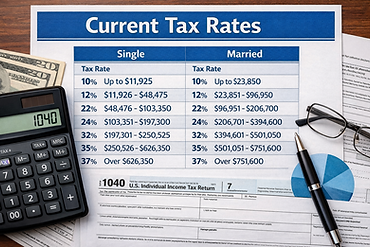
The U.S. tax system is progressive, meaning income is taxed in layers, or brackets. As your income increases, only the portion that falls into a higher bracket is taxed at a higher rate—not your entire income. This is where marginal and effective tax rates come into play.


Your marginal tax rate is the tax rate applied to your last dollar of income. In other words, it’s the rate you’ll pay on your next raise, bonus, or additional income. For example, if you fall into the 22% federal tax bracket, that does not mean all your income is taxed at 22%. It means the top portion of your income, the amount that spills into that bracket is taxed at 22%.


This rate matters most for decision-making. When evaluating whether to take on extra work, sell an investment, or convert retirement assets, your marginal tax rate helps estimate how much of that additional income you’ll actually keep after taxes.


Your effective tax rate, on the other hand, tells a different story. This is your average tax rate across all your taxable income. It’s calculated by dividing the total tax you paid by your total income from all sources. Because income is taxed progressively, your effective rate is almost always lower than your marginal rate.


For example, someone earning $120,000 as a married couple filing jointly might fall into the 22% marginal bracket. However, after accounting for lower brackets and deductions, their effective tax rate could be closer to 13–14%. This number is helpful for understanding your overall tax burden, comparing year-to-year changes, and planning household cash flow.


Confusion between these two rates is common and it often leads to bad financial assumptions. Many people believe that earning more money will push all their income into a higher tax bracket, resulting in less take-home pay. That’s simply not how the system works. Only the income above each threshold is taxed at the higher rate, which means earning more almost always results in more net income, not less.


Deductions can further complicate but improve the picture. Taxpayers can reduce taxable income by choosing between the standard deduction or itemized deductions, whichever is higher. For most people, the standard deduction makes sense because it’s simple and generous. For others especially homeowners, high charitable givers, or those with large medical expenses itemizing may lower their tax bill even more.


The key takeaway is this: your marginal tax rate affects future decisions, while your effective tax rate reflects reality. One tells you what happens to the next dollar you earn; the other tells you how much you actually paid overall.

Understanding the difference helps you make better choices, avoid unnecessary fear around tax brackets, and plan with confidence. Taxes may be complicated but knowing how these two rates work puts you firmly back in control of the conversation and your financial strategy.


120514_WWBrock_1

Wendell W. Brock, MBA, ChFC

Subscribe by Email

Follow Me

Most Popular Posts

Other Sites I Follow, hobbies, fun and info:

gold-vs-silver-1.jpg  Nauvoo Mint brokerage services for precious metals


john Mauldin chair

Note:

Outside Economics is not a registered investment advisory firm (RIA) and does not act as an RIA. Outside Economics does not provide any specific investment advice. Any information obtained from this website or through one of  Outside Economics' representatives should be reviewed by a professional.

Subscribers Note: We do not sell our email list. Period. Thank you for subscribing.

Recent Posts