Outside Economics

Owner's Equivalent Rent

Posted by Wendell Brock on Mon, Jul 15, 2024

Owner's Equivalent Rent

  • Wendell Brock
  • Jul 15, 2024
  • 1 min read

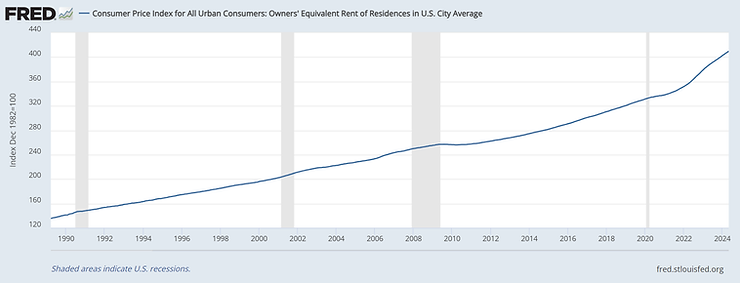
Owner’s Equivalent Rent (OER) is an economic indicator used to measure the cost of renting a home compared to owning it. It represents the amount a homeowner would pay to rent their home. This tool is used by economists and policymakers to calculate the cost of housing in inflation indices like the Consumer Price Index (CPI). OER is determined by comparing the costs of owning a home (including mortgage payments, property taxes, maintenance costs, etc.) to the rental value of similar properties in the housing market.

OWR is used because it reflects changes in housing costs that affect homeowners and renters alike, providing a comprehensive measure of housing cost inflation. Changes in OER can affect the CPI, and through a domino effect, monetary policy decisions, which impact overall inflation and cost of living calculations.


Secure a Flexible Retirement

Posted by Wendell Brock on Mon, Jul 15, 2024

Secure a Flexible Retirement

  • Wendell Brock
  • Jul 15, 2024
  • 2 min read

In order to create a secure retirement plan, a little flexibility is needed. Often people think a retirement plan needs to be strict and rigid, which they can be, however, developing a flexible plan allows you to live comfortably and securely without the unnecessary     restrictions.


Using annuities can be a great way to create a flexible retirement plan. Using careful consideration of your financial goals, risk tolerance, and your personal retirement timeline, you can develop a retirement plan that meets your needs and gives you the freedom to enjoy your post-working years.


An annuity is a financial product offered by insurance companies that provides regular payments over a specific period of time.


The first step is to assess your retirement needs and goals. This means estimating your retirement expenses and   determining your expected retirement age and the length of time you’ll need income. You’ll also need to evaluate how much risk you’re willing to take. (This can help determine which type of annuity will work best for you).


Annuities offer flexibility through their different options. There are Immediate or Deferred annuities, Fixed or   Variable annuities, and Indexed annuities. Each provides unique options allowing you to choose something that aligns with your retirement goals and risk tolerance.

Annuities also offer additional features and riders that allow you to support the flexible and secure retirement you’re planning for. They offer options like Guaranteed Minimum Income Benefit which provides a minimum income amount regardless of market performance, Long-Term Care  Riders which allow you to use annuit funds to cover long-term care expenses if needed, and Death Benefit Riders which guarantees that your beneficiary receives a certain minimum amount if you pass away before receiving all annuity payments.


An annuity can be part of a diversified retirement strategy that includes other investments like stocks, bonds, and savings accounts. This diversity helps you manage your risk and optimize returns over time giving you better flexibility and security.


Remember, flexibility does not mean unstable. Instead, it can provide more stability, giving you options. Using  multiple annuities in succession can give you this desired workability along with a reliable income.


An Unreachable Dream?

Posted by Wendell Brock on Mon, Jul 08, 2024

An Unreachable Dream?

  • Wendell Brock
  • Jul 8, 2024
  • 3 min read

There is an expectation in America that when children grow up and go out into the world they will be able to provide for themselves, every parent’s dream. Part of that is the ability to pay for housing. Yet nowadays, many young people are questioning if they can afford to buy a house in this economy. Worse is the cost of owning a home, which goes way beyond the initial price tag, making home ownership seem like an unobtainable dream for more than just the young adults of society. Below are some of the factors that have increased the cost of home ownership.


The national average sales price of an existing single-family home in the U.S., as of earlier this year, is $375,000. This number could vary greatly depending on where you are looking to buy a home. The current interest rate, depending on your type of mortgage, can range from 6.3% to 7.16%. While these rates are higher than the historically low rates of the past 15 years, they are more in line with the normal range of mortgage rates.


Moreover, the rise in homeowner’s insurance premiums continues to push the dream of owning a home even further out of reach. According to the National Association of Realtors, homeowners nationwide are expected to see a 6% increase in premiums by the end of the year. This is on top of the 20% increase over the previous two years.


The cost of owning a home has surged in the last four years. If someone were lucky enough to have enough cash to pay the full value of a home and eliminate the added cost of paying interest, they would still have the on-going costs of living in and maintaining that home. Expenses such as homeowners’ insurance, property taxes, utilities, and the cost of upkeep and repairs add up very quickly. These costs have gone up by 26% since 2020 coming to about $18,000 per year, with some states paying as much as $25,000.


On top of the rising costs, another obstacle making it difficult for aspiring homeowners is the imbalance between housing supply and demand. The U.S. population grew by more than 1.75 million during 2023, coupled with a push toward urbanization the housing markets in many metropolitan areas is strained. Many cities have seen prices soar way beyond the national average, driven by limited available land for new construction, zoning regulations that restrict development, stricter building codes, and the bloated costs of building materials and labor.


These unfavorable conditions can truly make home ownership seem impossible, but there are steps to take that can help you get your foot in the door. Create a financial plan and a budget then STICK TO IT. One idea, as part of the plan, is to save the difference between rent and home ownership. If rent is $2,000 per month and home ownership would cost $3,000 per month, then save the $1,000 per month towards home ownership.


No doubt, home ownership takes sacrifice, your budget needs to reflect that. The larger your down payment, the smaller your mortgage payments will be. One of the major benefits of owning a home is that the mortgage payment is typically fixed for the life of the loan. Unlike rent which can and often increases over time. Owning a home may seem like a farfetched dream, but through dedication and smart planning, it is possible.



120514_WWBrock_1

Wendell W. Brock, MBA, ChFC

Subscribe by Email

Follow Me

Most Popular Posts

Other Sites I Follow, hobbies, fun and info:

gold-vs-silver-1.jpg  Nauvoo Mint brokerage services for precious metals


john Mauldin chair

Note:

Outside Economics is not a registered investment advisory firm (RIA) and does not act as an RIA. Outside Economics does not provide any specific investment advice. Any information obtained from this website or through one of  Outside Economics' representatives should be reviewed by a professional.

Subscribers Note: We do not sell our email list. Period. Thank you for subscribing.

Recent Posts