
Outside Economics

Entrepreneurs, The Life Blood of Freedom

Posted by Admin on Tue, Feb 12, 2019

Entrepreneurs, The Life Blood of Freedom

  • Feb 12, 2019
  • 4 min read


The word “entrepreneur” originates from a thirteenth-century French verb, entreprendre, meaning “to do something” or “to undertake.” By the sixteenth century, the noun form, entrepreneur, was being used to refer to someone who undertakes a business venture. The first academic use of the word by an economist was likely in 1730 by Richard Cantillon, who identified the willingness to bear the personal financial risk of a business venture as the defining characteristic of an entrepreneur.


In the early 1800s, economists Jean-Baptiste Say and John Stuart Mill further popularized the academic usage of the word “entrepreneur.” Say stressed the role of the entrepreneur in creating value by moving resources out of less productive areas and into more productive ones. Mill used the term “entrepreneur” in his popular 1848 book, Principles of Political Economy, to refer to a person who assumes both the risk and the management of a business. In this manner, Mill provided a clearer distinction than Cantillon between an entrepreneur and other business owners (such as shareholders of a corporation) who assume financial risk but do not actively participate in the day-to-day operations or management of the firm.


Successful entrepreneurs expand the size of the economic pie for everyone. Bill Gates, who, as an undergraduate at Harvard developed BASIC for the first microcomputer, went on to help found Microsoft in 1975. During the 1980s, IBM contracted with Gates to provide the operating system for its computers, a system now known as MS-DOS. Gates procured the software from another firm, essentially turning his invention into a multibillion-dollar product. Microsoft’s Office and Windows operating software now run on about 90 percent of the world’s computers. By making software that increases human productivity, Gates expanded our ability to generate output (and income), resulting in a higher standard of living for all.

Sam Walton, the founder of Wal-Mart, was another entrepreneur who touched millions of lives in a positive way. His innovations in distribution warehouse centers and inventory control allowed Wal-Mart to grow, in less than thirty years, from a single store in Arkansas to the nation’s largest retail chain. Shoppers benefit from the low prices and convenient locations that Walton’s Wal-Marts provide. Along with other entrepreneurs such as Ted Turner (CNN), Henry Ford (Ford automobiles), Ray Kroc (McDonald’s franchising), and Fred Smith (FedEx), Walton significantly improved the everyday life of billions of people all over the world.


Economists William Baumol and Peter Boettke popularized the idea that free market capitalism is significantly more productive than alternative forms of economic organization because, under capitalism, entrepreneurial effort is channeled into activities that produce wealth rather than into activities that forcibly take other people’s wealth.

Baumol and Boettke insist that entrepreneurs are present in all societies. In government-controlled societies, entrepreneurial people go into government or lobby government, and much of the government action that results — tariffs, subsidies, and regulations, for example — destroys wealth. In economies with limited governments and rule of law, entrepreneurs produce wealth.


Some entrepreneurs have some serious challenges with their businesses. While I don't condone certain businesses that are legal in our country, that does not mean they don't have specific challenges. The new cannabis  businesses in Colorado for example are having difficulty establishing banking relationships, primarily due to banking regulations. Which many would argue limits an entrepreneur's freedom.


Baumol’s and Boettke’s idea is consistent with the data and research linking economic freedom, which is a measure of the presence of good institutions to both entrepreneurship and economic growth. The recent academic research on entrepreneurship shows that, to promote entrepreneurship, government policy should focus on reforming basic institutions to create an environment in which creative individuals can flourish. That environment is one of well-defined and enforced property rights, low taxes and regulations, sound legal and monetary systems, proper contract enforcement, and limited government intervention.

Research is showing that the public policy that best fosters entrepreneurship is economic freedom. It focuses on the reasons why government programs are likely to fail, and on how improved “rules of the game” (lower and less complex taxes and regulations, more secure property rights, an unbiased judicial system, etc.) promote entrepreneurial activity. Steven Kreft and Russell Sobel (2003) showed entrepreneurial activity to be highly correlated with the “Economic Freedom Index,” a measure of the existence of such pro-market institutions.

Economists find that infusions of venture capital funding do not necessarily foster entrepreneurship. Capital is more mobile than labor, and funding naturally flows to those areas where creative and potentially profitable ideas are being generated. This means that promoting individual entrepreneurs is more important for economic development policy than is attracting venture capital at the initial stages. While funding can increase the odds of new business survival, it does not create new ideas. Funding follows ideas, not vice versa.

There are many entrepreneurship quotes that are relevant and important to every entrepreneur’s journey. Here are a few favorites:


It’s fine to celebrate success but it’s more important to heed the lessons of failure.– Bill Gates

I have not failed. I’ve just found 10,000 ways that won’t work.– Thomas Edison


Success is walking from failure to failure with no loss of enthusiasm.– Winston Churchill


It’s not about the ideas. It’s about making the ideas happen.– Scott Belsky


Ideas are easy. Implementation is hard.– Guy Kawasaki


Timing, perseverance, and 10 years of trying will eventually make you look like an overnight success. — Biz Stone


No more romanticizing about how cool it is to be an entrepreneur. It’s a struggle to save your company’s life – and your own skin – every day of the week.– Spencer Fry


See things in the present, even if they are in the future.– Larry Ellison


All our dreams can come true, if we have the courage to pursue them.– Walt Disney


Failure is simply the opportunity to begin again, this time more intelligently.– Henry Ford


If you want to succeed you should strike out on new paths, rather than travel the worn paths of accepted success. — John D. Rockefeller


Go as far as you can see; when you get there, you’ll be able to see further. — JP Morgan


It is critical that we as a country support the principals of free enterprise and entrepreneurship, the largest breaks on the system is the government and all the regulation it has created. Regulations are typically there to help “protect the people”; but all too often these same regulations impede progress and development of new products which can help people even more. How do regulations slow the progress of your business?



What's the deal with my Home Insurance?

Posted by Admin on Thu, Feb 07, 2019

What's the deal with my Home Insurance?

  • Feb 7, 2019
  • 4 min read

Homeowners insurance can be very confusing - let’s be honest how many of you have actually read your policy and know its limits, etc.? That's what I thought, not many! After all we only have it because it is required by the mortgage lender and we are confident that, just like life insurance, it will never happen to us, so we would skip it and save the money - right? Even though for many Americans their home is their second most important asset (You can ask me later what the first most important asset is).


If life insurance is any indicator then a full forty percent of the homes would not be insured, simply because that is how many people run around without life insurance. But I digress, back to the subject of homeowners insurance.


Years ago I bought a rental house with my older brother and his wife. Yes the three of us were business partners, imagine going into business with a family member! I owned half and they owned the other half. Well we all remained great friends and kept our family relationship in top order - while the partnership ended 20 years ago when we sold the house, I would do it all over again with them, they were the best business partners I could have had at that young age. 


We had a tenant whose 12 year old son was caught playing with matches - unfortunately he was caught after the house caught fire and burned down! They lost everything they owned (they did not have renters insurance) we lost a house. So I know first hand about a house fire and the importance of maintaining the proper insurance.


There are two general types of property coverage for residential real estate: dwelling and homeowners policies. 


Dwelling policies are more limited in their scope of coverage, the policy is more basic for the property and most things are added via a “rider” to the policy. Perhaps you could say it is an alls-carte - you can pick and choose what you may need. Often they are used to cover rental houses or vacation homes.


A homeowner policy is more of a package of coverages for the owner of the property. It will typically have the broadest coverages. These policies have two parts: 1. the property coverage, insuring the home and contents, and 2. providing liability coverage, should there be a problem, where the owner is liable for something occurring on the property or through some sort of bad act by the property owner or an immediate family member for which he/she may be responsible.


Having the proper amount of insurance coverage is key. This can be tricky with home values changing on a regular basis. However, you should have the value of the home evaluated on a regular basis.


Here is the rule:

In order to have your home properly insured the insurance property coverage must equal a minimum of 80 percent of the replacement cost of the home. The home’s market value is a pretty good estimate of this figure as replacement cost is one of the factors that contributes to a home’s market value. 


People often ask, why 80 percent and not 100 percent? The reason is that traditionally, 20 percent of the home’s value is placed in the value of the land upon which the home sits. If the home is damaged generally speaking the land is not and a new home can be rebuilt in its place, making the land a consistent value of the overall property.

Here is the formula for replacing a damaged home:

(Insurance carried/Insurance required) x amount of loss = amount of reimbursement

This is how it works in real life, a homeowner experiences a $100,000 loss on their home worth $300,000. 80 percent of $300,000 is $240,000, this is the amount of coverage a homeowner should carry. Now lets put this into the formula:

(240,000/240,000) x $100,000 = $100,000 In this case the homeowner would be reimbursed the full amount of the loss.


Here is another example, in this case the same homeowner had not updated their policy in several years, which let the policy fall behind the value of their home, they did not maintain the 80%. The coverage they carried was based on a home value ten years ago when they purchased the home at $200,000, required coverage at that time was only $160,000.

($160,000/$240,000) x $100,000 = $66,667, this is what the homeowner would receive for their $100,000 loss. The balance they would have to come out of pocket to complete the required repairs. 


Falling behind on the insurance can be a real problem in high inflationary times because values can increase rapidly

As a side note, neither of these examples takes into account the deductible, that amount would be deducted from the amount of the reimbursement to get the final reimbursement amount. A homeowners policy may have different deductibles for different types of losses, so it is wise to keep track of that deductible amount. This is where a good savings plan is helpful to have the funds at the ready for such a need.


Many people go through life never experiencing such a loss to their home or property, however that does not mean that you should not be covered. This is something that you don’t want to “self insure”, maintain adequate coverage because if and when something happens, you will be glad you did. Pull out your homeowners policy and review it. Make sure the coverages work for your personal situation. If it is lacking in any area call the agent and get it updated or call me and I can walk you through each of the issues.


REMEMBER:

Regarding Hot Tips: "Assume you are always the last to know." ~ Charles Kirk


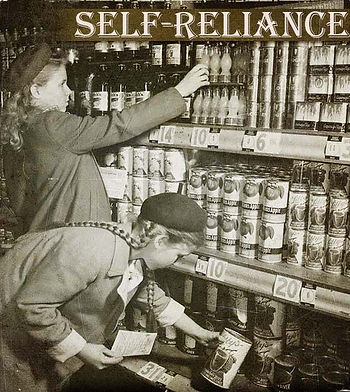
Six Tips to Becoming Self Reliant

Posted by Admin on Thu, Feb 07, 2019

Six Tips to Becoming Self Reliant

  • Feb 7, 2019
  • 3 min read

Recently I was in a meeting and the thought occurred to me; why do people even attempt to have a financial plan? What is the purpose of having a financial plan? Why take the time to create a financial plan and put forth the effort to implement it and follow through with it? The answer to these questions may sound obvious, but as I have studied financial planning and worked in the financial industry for the past 30 years, I have concluded that people have an innate desire to be self-reliant. However being self-reliant is a learned trait while we may have the innate desire, we have to act on it, and learn self-reliance.


What does it mean to be self-reliant? According to Dictionary.com, the adjective originated around 1826 and means, “relying on oneself or on one’s own powers, resources, etc.” Another definition, one that is a little broader is this: The ability, commitment, and effort to provide for the spiritual and temporal necessities of life for self and family. Both definitions explain the necessity to provide for one’s self.


The second definition is more comprehensive. My thinking is; how can you be self-reliant if you are not mentally or spiritually in the game? Can someone provide for self and others without that inner strength that comes from being mentally or spiritually prepared? I believe that self-reliance is more than just a good job and a fat bank/retirement account(s).

Self-reliant people not only have a good source of income, they have money in the bank, investments, as a friend of mine would add some food storage, debt free, and they are spiritually and mentally able to care for their own. This is a challenge in todays world where people are pulled in every direction, often wasting time and money. In some cases, children don’t have a complete understanding of what it took to earn the money they are now spending. 


With the challenges of providing for one’s self and family, may I submit that it would also include the necessity to continue to learn and improve one’s self. Consistently learning and integrating new concepts of truth, would help a person accomplish a goal of self-reliance. For example read good books, work with a mentor, be a mentor, help someone else reach their goals.


How does someone become self-reliant? Here are six ideas that will help you become more self-reliant:


1. Pay yourself first: Take some money out of each pay check and send it to savings (savings accounts, retirement accounts, investment accounts). The discipline of saving money and living on less than one’s income is a critical part of self-reliance.


2. Using a family budget: Using a budget is one of the basic principles of good money management.


3. Risk management: Risk management is taking care of the risks we are exposed to on a daily basis. There are four things that can be done with the risks: Keep the risk yourself and personally pay for the things that may happenControl the risk through behaviorPrevention - don’t engage in behavior/activity that would enhance the riskTransfer the risk through some means of insurance.


4. Be prepared: Things happen in life that cause great pain or financial difficulty (loss of a job, divorce, death of a loved one, business reversal, etc.) These trials may cause us to stretch and grow in ways we never knew we could, so finding, and developing coping skills is critical (developing the mental/spiritual side of self-reliance).


5. Daily improvement: Find something to do on a daily basis that will help you improve various aspects of your life. For example each morning, I spend time, praying, reading, writing in a journal, exercising, and meditating. 


6. Become debt free: Debt is truly a bondage that never sleeps, never eats, is always your companion where ever you go; becoming debt free is a blessing of self-reliance. Get out of debt!


These steps towards complete self-reliance take time and work. Don’t be too hard on yourself if you are not self-reliant in the next year - keep working towards it. “Claim progress”, as my wife would say. Map these things out how you personally might implement them in your own families’ and measure your progress. And then realize that life happens and each of us can experience a reversal.


Reversals that can cause a person to be completely wiped out and they have to start over, some people go through life with no issues at all (at least not that we see), so be patient with people around you as we are all be on the road to self-reliance, we aren’t at the same level, or we may have just suffered a reversal.


Finally, remember that there is always hope; keep the embers of hope alive by working on the above six items in some manner, as part of your financial plan regularly measure and keep track of your efforts, and you will become self-reliant.


REMEMBER:

"Strive not to be a success, but to be of value." ~ Albert Einstein


120514_WWBrock_1

Wendell W. Brock, MBA, ChFC

Subscribe by Email

Follow Me

Most Popular Posts

Other Sites I Follow, hobbies, fun and info:

gold-vs-silver-1.jpg  Nauvoo Mint brokerage services for precious metals


john Mauldin chair

Note:

Outside Economics is not a registered investment advisory firm (RIA) and does not act as an RIA. Outside Economics does not provide any specific investment advice. Any information obtained from this website or through one of  Outside Economics' representatives should be reviewed by a professional.

Subscribers Note: We do not sell our email list. Period. Thank you for subscribing.

Recent Posts