Outside Economics

How Does Residential Tax Affect You?

Posted by Wendell Brock on Mon, Feb 19, 2024

How Does Residential Tax Affect You?

  • Wendell Brock
  • Feb 19, 2024
  • 3 min read


For many Americans one of their largest single assets is their principal residence. How income taxes affect a family’s principal residence is a very important consideration, so let’s look at some of these items and hopefully help make the tax questions easier. Here are the basics on the sale of a home:


Principal Residence

A taxpayer, either single, married filing joint (MFJ), or head of household (HH) can only have one principal residence per year; meaning, if you own multiple properties, only one can be your principal residence. Several factors determine your principal residence:


1.     The amount of time spent at each residence. Where did you and/or your family live the most? A summer cottage does not count as a principal residence, unless you live there most of the time.

2.     Place of employment. What is the proximity of the taxpayer's employment to the house that is being claimed as the principal residence? Is the other house closer?

3.     Location of family members. Where do the family members live (spouse, children, other dependents, etc.)? Do they live in the house that is being claimed as the principal residence or the last claimed principal residence?

4.     What address is listed on federal and state tax returns?

5.     Auto and voter registration, are they consistent with the address for the principal residence?

6.     The mailing address for bills and other correspondence. Are the pieces of mail delivered to the principal residence or some other place?

7.     Where does the taxpayer do business with banks, churches, clubs, schools, cell towers showing phone activity, etc.?

These represent items the IRS would inquire about if a taxpayer was to claim a home different than their past home as their principal residence, particularly when it comes to the sale of the property and in claiming a section 121 exemption for capital gains tax.


Section 121 Exclusion

The section 121 exclusion allows for a taxpayer to exclude up to $250,000 for single or HH and $500,000 for MFJ of capital gains on the sale of a principal residence. This can be a significant amount of money for some taxpayers, who are near retirement and want to downsize, or others who need to move to a new home for any of several reasons.


As with most IRS regulations there is an ownership and occupancy test to make sure the taxpayer is entitled to the exclusion, here is the test for Section 121:


1. The taxpayer needs to have owned the house for at least two years during the five-year period before the house is sold. For a married couple, only one spouse has to meet the ownership test.

2. Occupancy test. The taxpayer must actually live in the residence; simply moving furniture in does not count. You can have short, temporary absences including vacations up to two months. A year-long sabbatical, for example, is not a temporary absence. However, if the home was destroyed or condemned, time in the home may count towards the ownership and occupancy. For married couples, both must have lived in the house for two years.


If a taxpayer did not use the exemption in the previous two years, they can take the section 121 exclusion. There are exceptions to the tests for deployed military personnel, senior foreign service personnel, etc. Under certain circumstances a partial exclusion maybe applied for.


There are other details that may or may not affect your particular situation, this was meant to be a basic explanation of how the sale of a principal residence would affect a taxpayer. If you have any questions give us a call and we will do our best to sort out the issue to get you the correct answers.


Photo by Todd Kent



What It Means To Be a Caregiver

Posted by Wendell Brock on Mon, Feb 12, 2024

What It Means To Be a Caregiver

  • Wendell Brock
  • Feb 12, 2024
  • 2 min read

It’s usually pretty easy to love and care about the people in our lives, especially when it comes to family, but sometimes life calls on us to take that a step further and become caregivers.


People become caregivers for many different reasons. Often times, an elderly parent is in need of care from their children, sometimes a grandparent steps in to care for a grandchild. Other times, it could be the need of a sibling or other relative, or perhaps a friend stepping in to help another friend or neighbor. However, it comes about, becoming a caregiver can be both rewarding and burdensome. 


A caregiver is someone that provides care and tends to the needs of a person with short- or long-term limitations due to age, injury, disability, or illness. This could mean providing physical, social, medical, and emotional support. While it’s easy to list the black and white expectations of a caregiver, it goes much deeper than superficial actions. Being a caregiver means becoming an advocate, a cleaner, a medication dispenser, a cook, and requires flexibility. All those responsibilities can feel overwhelming. It can also create a huge financial  burden to both the person needing care and the caregiver. A study done in 2011 showed that women over 50 who leave the workforce to care for a loved one lose up to $324,000 in wages, Social Security   benefits, and private pensions over their lifetime      because of their caregiving responsibilities.


Being a caretaker is not all bad, though. It is, in fact, a wonderful opportunity to develop a sense of empathy and greater understanding of others. It allows you the chance to learn patience and problem-solving and enhance communication skills. You can develop many abilities that could be useful in other areas of your life.


So where is the balance between the overwhelm and the reward? A lot of it comes down to how well the person needing aid has prepared financially. When people include a Long-Term Care (LTC) policy in their retirement and financial plan it ensures that if the time comes, there is money set aside for their needs, easing the burden a lack of money could place on them and their caretaker. Having LTC insurance in place changes the role of the caregiver to a care manager, allowing them to pay for professional help when needed, relieving the burden of being a sole caregiver. The role change can also relieve other personal burdens felt as a caregiver, reducing the pressure it places on their family and work life. However, one of the greatest blessings comes from the piece of mind it can provide.


Being a caregiver can be a rewarding and fulfilling role. It provides an opportunity to give back and help someone else. It’s important to plan financially and avoid the negative pitfalls of being financially unprepared. Having a LTC policy could be an option as you plan for your future retirement needs, for both you and your loved ones that would be taking care of you, providing peace of mind for everyone involved.


Photo by Lina Trochez


Producer Price Index

Posted by Wendell Brock on Sat, Feb 10, 2024

Producer Price Index

  • Wendell Brock
  • Feb 10, 2024
  • 1 min read

The Producer Price Index (PPI) is an inflationary measure similar to the CPI. The difference, though, is while the CPI measures the change in what a consumer pays, the PPI measures the change in what the producer or manufacturer pays for the raw materials they use. Over 16,000 establishments provide about 64,000 price quotations every month creating the pool of information used to determine the PPI. The monthly PPI report publishes more than 3,800 commodity price indexes for goods and more than 900 services.


The PPI helps economists foresee inflation. It is also used for tracking price changes by industry and comparing wholesale and retail price trends. The PPI does not include the price of imported goods; however, it does include export prices. The PPI is useful for tracking the production flow price changes as products move through the various stages of production and manufacturing. This allows the production flow to be monitored, which helps economists to assess the degree of change in inflation rates producers face at earlier stages of production and throughout the manufacturing process to the final product.

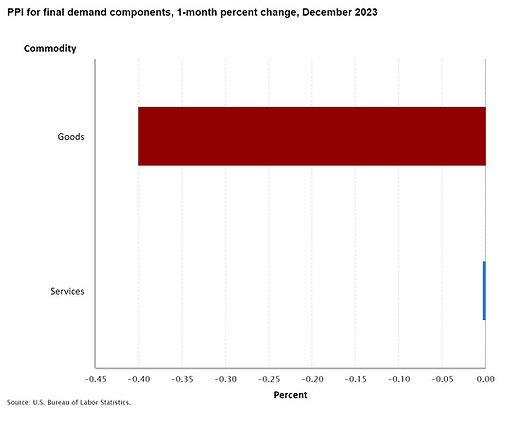
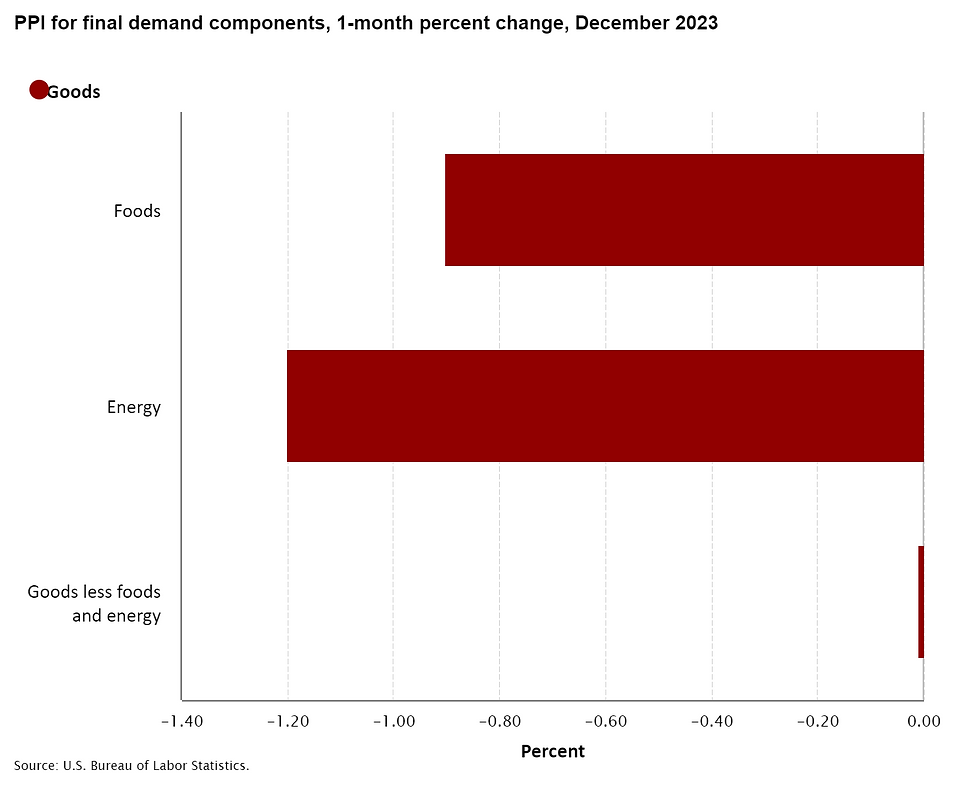
The Producer Price Index for final demand fell 0.1 percent in December. Prices for final demand goods decreased 0.4 percent, while the index for final demand services remained unchanged. Prices for final demand rose 1.0 percent in 2023.


120514_WWBrock_1

Wendell W. Brock, MBA, ChFC

Subscribe by Email

Follow Me

Most Popular Posts

Other Sites I Follow, hobbies, fun and info:

gold-vs-silver-1.jpg  Nauvoo Mint brokerage services for precious metals


john Mauldin chair

Note:

Outside Economics is not a registered investment advisory firm (RIA) and does not act as an RIA. Outside Economics does not provide any specific investment advice. Any information obtained from this website or through one of  Outside Economics' representatives should be reviewed by a professional.

Subscribers Note: We do not sell our email list. Period. Thank you for subscribing.

Recent Posts