
Outside Economics

Falling Labor Productivity

Posted by Wendell Brock on Fri, Sep 23, 2022

Falling Labor Productivity

  • Wendell Brock
  • Sep 23, 2022
  • 2 min read

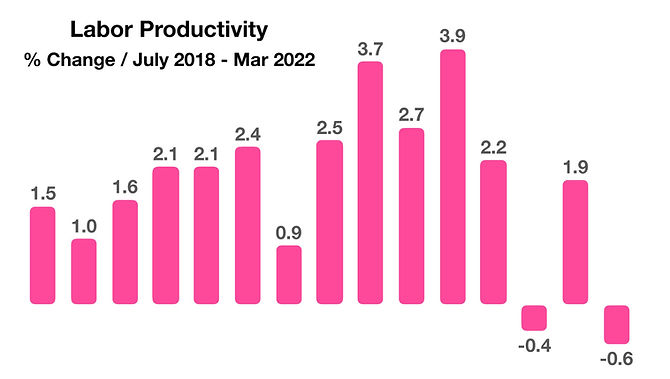
The most recent data released by the Labor Department revealed the largest quarterly drop in productivity since 1947, decreasing at an annualized rate of 7.5%. The drop in productivity was concurrent with the largest rise (11.6%) in labor costs since 1982. Both of these measures are also indicators of inflationary pressures for both companies and consumers. Many companies have been passing along higher costs to consumers, raising prices across the country faster than they have in the last 40 years. Eventually prices will be forced to level out because of competition between companies which will hold prices steady which will require these companies to absorb the higher costs. This could lead to decreased levels of hiring and lower wages as companies struggle to maintain profitability levels.

Data surrounding labor during the pandemic has been considered unreliable and inconsistent by many economists, meaning that the true effects of the COVID-19 pandemic and worker retention are still not certain. An essential data set is labor productivity, which is a measure of how efficiently companies are utilizing workers to produce products and services. This year, the largest four-quarter drop in labor productivity was observed since the fourth quarter of 1993 according to the Bureau of Labor Statistics, marking a historic decline in productivity. Another Labor Department report showed that jobless claims increased to 200,000 at the end of April, the overall number falling to 1.38 million, the lowest level since January of 1970.

Federal Reserve survey results, reported in the Fed’s Beige Book, have identified that a growing number of manufacturers and industrial companies are


increasingly moving towards automation, replacing previously desired workers with robotic gear. Rising wages and a dwindling labor pool have forced some companies to resort to machines instead of hiring workers.



Put Your Profit First

Posted by Wendell Brock on Fri, Sep 16, 2022

Put Your Profit First

  • Wendell Brock
  • Sep 16, 2022
  • 2 min read

When managing your personal finances, we’ve talked about how important it is to pay yourself first-to put money into savings and then budget and spend what is left over. This creates a stable financial foundation to build from and rely on. When running a business, it’s important to follow the same principle and put your profit first. To have a successful business you need to make a profit. The strength and longevity of your business only lasts while it’s profitable. When you put your profit first you are determining to stay in business.

What does it mean to put your profit first? Traditional accounting says, expenses are deducted from sales and what is left over is considered your profit.

[Sales – Expenses = Profit]

But, just like paying yourself first, you take a percentage from each sale as profit and then use the remainder to pay for expenses.

[Sales – Profit = Expenses]

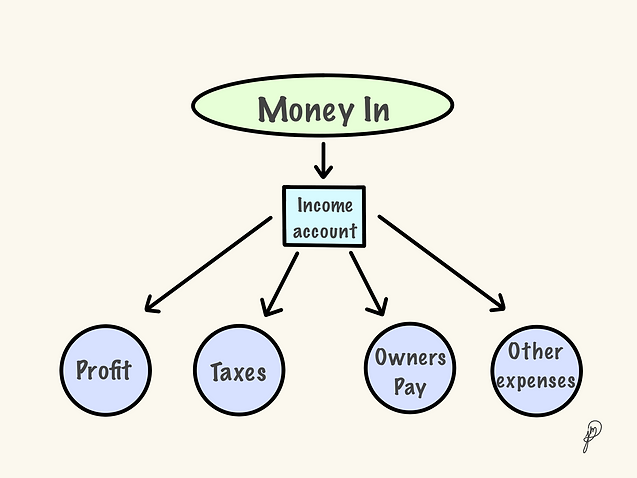
The overall goal is to develop a system that will build your business in a sustainable way in order to create long term success. Big picture, you would be grouping portions of the business sales and putting them into separate accounts. These will be comprised of profit, taxes, operating expenses, and owner’s pay. To make this system work you will put predetermined percentages of your sales into the various bank accounts starting with the profit account. How much you put into each account is determined by your Target Allocation Percentages (TAPs). This will be a shift from the Current Allocation Percentages (CAPs).


At first this may be a difficult thing to do, as it goes against the traditional model, but making the shift mentally and committing to the future of your business will make all the difference. When you consciously put money into your separate accounts it makes you more aware of how you are spending your money and helps you to spend more wisely. All of the accounts together can help give you a visual map of where your company is at and help you see how to get to where you want your company to go.

Perhaps the hardest part of this process is managing your expenses. Initially, you may need to cut back on your unnecessary expenses. This is a hard thing to do, but remember it’s a lot easier to cut expenses than it is to conjure up new sales. When making purchases or analyzing expenses the key thing is asking yourself, “do I (or my business) really need this?” If you’re able to determine that it isn’t necessary, or could potentially hurt your profits, cut it from your spending. It could take a few months to pay down debts, but by whittling down your expenses and being more conscientious you will start to build your cash reserves.

Eventually the goal is to learn how to enjoy saving your money as much, if not more, than spending it. When something makes you happy, you’ll keep doing it. Celebrate the moments when you opt out of spending unnecessary money, make it a big deal. Over time, you’ll build momentum and you will enjoy those moments and establish good, healthy money management.


Life Insurance Awareness Month

Posted by Wendell Brock on Fri, Sep 09, 2022

Life Insurance Awareness Month

  • Wendell Brock
  • Sep 9, 2022
  • 3 min read

Updated: Sep 19, 2022


As of a 2021 only 52% of Americans have life insurance, according to LIMRA, and of those covered half are underinsured, meaning about three fourths of Americans will likely struggle to make ends meet in the wake of losing a loved one. With these numbers in mind, and since September is Life Insurance Awareness Month, I felt it an important topic to discuss. There are myriad reasons why so many people don’t have coverage. Some people might have other financial priorities, or they might not know how to go about finding the right coverage. Sometimes people are relying on a life insurance policy provided through their work and feel that is enough, neglecting the fact they will lose their insurance if they leave that company. Other people think life insurance costs more than it really does, or may have other misconceptions that prevent them from taking action. I’d like to shed a little light on this important aspect of financial planning and provide some insight so you can make the decision that is best for your family.

So, who needs life insurance? The short answer- everyone. Even the most wealthy need life insurance coverage. Whether you’re rich or poor, the government still needs to be paid, funeral expenses need to be covered, and life’s other demands will persist; if you don’t have life insurance your family may have to sell off possessions and other assets to cover final costs and maybe estate taxes. An old friend, who was a mortician by profession, told me once the thing he hated most about his job was putting a family in debt to bury a child. Having life insurance, and appropriate coverage, provides your family with options, giving them peace of mind and freedom from debt.

Life insurance is a bit of a misnomer because it’s not really about insuring your life, as much as actually insuring that your loved ones are taken care of after an unexpected death. Let’s face it, we’re all going to pass away sometime, and no one knows exactly when. It’s better to have the peace of mind knowing if death comes unexpectedly, stress over money won’t have to add to an already difficult time.

You spend your life working hard to provide for your family, you don’t want all your effort to be undone when you die. I’ve known people of all ages and in all different family circumstances, mature people, married with or without children (young or adults), young newly married with no kids or older people who are single that passed away unexpectedly. Every life has value to those left behind.

Once you decide to purchase life insurance you’ll need to figure out how much coverage your family will need. A general rule is to estimate ten to twenty times your annual earnings. To gain a better idea, it’s best to remember the why. Why will your family need this money, what financial obligations will they need to cover to maintain their security? This number may change over time, just as your life circumstances change. When you’re first starting out, you’ll want to make sure your mortgage, utilities, groceries, as well as other day to day expenses are paid for, maybe even the extra cost of your children’s education. Later in life, your focus might be on ensuring your spouse has a secure retirement. The goal is to have adequate coverage to pay all the known expenses and enough to cover the unexpected ones as well. This will provide stability and peace of mind. My father passed away when I was completing my second year of college. His life insurance policy helped my mother navigate the final expenses, and continue on. It provided some peace of mind that things would be o.k. And she did, she lived another 28 years.

There are many things in life to worry about, don’t let what will happen to your family after you pass be one of them.


120514_WWBrock_1

Wendell W. Brock, MBA, ChFC

Subscribe by Email

Follow Me

Most Popular Posts

Other Sites I Follow, hobbies, fun and info:

gold-vs-silver-1.jpg  Nauvoo Mint brokerage services for precious metals


john Mauldin chair

Note:

Outside Economics is not a registered investment advisory firm (RIA) and does not act as an RIA. Outside Economics does not provide any specific investment advice. Any information obtained from this website or through one of  Outside Economics' representatives should be reviewed by a professional.

Subscribers Note: We do not sell our email list. Period. Thank you for subscribing.

Recent Posts