Outside Economics

What is GDP?

Posted by Wendell Brock on Mon, Apr 10, 2023

What is GDP?

  • Wendell Brock
  • Apr 10, 2023
  • 2 min read

It’s hard to come across an economic report that doesn’t mention GDP. As far as financial or economic acronyms GDP, Gross Domestic Product, is probably one of the most used and recognized. Most people have at least a superficial understanding of what GDP is, but in the spirit of Financial Literacy Month, I’d like to delve a little deeper, and perhaps shed some light as to why this is such an important and commonly used gauge.

Gross Domestic Product is a limited measure of the U.S. economy. GDP tracks the value of the final goods and services that are produced in a country in a given year (this does not include items purchased in making a final product, hence the limitation). Changes in GDP are an indicator of the nation’s overall economic health. This is important because it provides insight about the size and overall performance of the economy. Like an electric meter measures the amount of energy a building uses, GDP measures the annual money flowing through the economy. Simply put, an increase in real GDP is a sign that the economy is doing well.
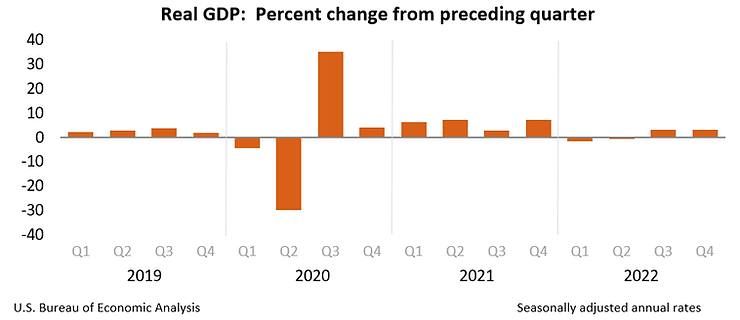

The government collects and compiles data through the Bureau of Labor Statistics (BLS). The data is collected through other federal agencies, such as the Census Bureau, the Bureau of Labor Statistics, and the Treasury. A new GDP report is released 4 times a year.

Because GDP is collected at current prices, it would not be accurate to compare data from two periods without making adjustments for inflation. In order to determine “real” GDP, prices have to be adjusted to account for the change, otherwise there would be no way to tell if the value of output has gone up because more is being produced or just because prices have increased. Another statistical tool is used to eliminate the effects of inflation to give real GDP, this is the version we need to look at.


The purpose of measuring GDP is to provide data about how fast the economy is growing, to see the spending patterns on goods and services, what percent of the increase in production is a result of inflation, as well as other economic factors.

It is also important to know what GDP is not. GDP is not a measure of the overall well-being or standard of living within a country. Although it is frequently assumed that a healthy economy equates to a higher standard of living, GDP does not capture many of the things that truly indicate well-being, since those things do not involve any transactions.

GDP is a specialized tool, which can be useful when used in its proper scope. GDP can help economists to see historical trends, make projections about the economic future, and compare our economy with other nations’. Understanding GDP can help support investment decisions and provide insight to our current economy.



Financial Literacy Month

Posted by Wendell Brock on Mon, Apr 03, 2023

Financial Literacy Month

  • Wendell Brock
  • Apr 3, 2023
  • 3 min read


In an effort to bring attention to the importance of teaching Americans, especially children, healthy financial habits, the U.S. Senate passed a resolution in 2003 designating April as Financial Literacy Month. The goal is to bring awareness to and teach the significance of financial literacy in our lives and help people understand their relationship with money. Many people grow up without being taught simple things like how to effectively budget, how to save and plan for retirement, the importance of managing debt, or how to invest in the stock market. While these concepts may seem simple, often, if one is not shown the first steps, it is difficult to take action.

Unfortunately, in spite of having endless information at our fingertips, many people, especially those belonging to and after the Millennial generations, are unprepared should they encounter a financial crisis. This month, I’d like to highlight some of the skills and components that help build financial literacy. As with most things, the earlier you start down the path of financial education, the better off you will be.

Budgeting

Budgeting might seem obvious, but knowing how to create and maintain even a simple budget is the first step to understanding your money. It helps you see how much you have and where it’s going. List your expenses, then list your income. Seeing where your money comes from and where it is going is crucial. If your outgoing money is more than your income, you need to make adjustments, otherwise you will become trapped in debt.

Saving

Saving money is a learned skill. It takes self-control, mindfulness, and practice. Understanding the importance of paying yourself first is one of the first steps to developing a good relationship with your money. Having an emergency fund that can cover three months’ expenses will protect you from debt and further money problems should something unexpected or problematic arise.

Investing

When you invest your money, you’re making your money work for you. There are many ways to invest your money. Many employers offer 401k options, but you can invest your money independently as well through mutual funds, ETFs, REITs, money market funds, etc. When investing in the stock market it is helpful to use a professional. However, often many chose to go it alone by using a digital platform. It will take research and a little experience to learn which investments are right for you and what risks your investments are exposed to.

Debt

The best way to handle debt is to never get into debt in the first place. However, that’s not always possible. Some things, usually, require debt, like purchasing a car, a house, or paying for higher education. However, when it comes to the day to day wants and needs, it’s important to set money aside. A good principle is to never go into debt for a liability. If you’re going to use credit, use it to invest in an asset. Student loans are an investment in education, which is something that you carry with you throughout your life; enhancing it and leading to greater opportunities. Therefore, it is an asset. On the other hand things like a vacation or even a box of donuts, (either will be gone within a few days) once the experience is over it no longer serves you. Those things become liabilities if purchased with credit. The goal is to keep your liabilities as close to zero as possible.

Your financial goals should include striving to develop skills and gaining knowledge that will allow you to make informed and effective decisions. This process is a lifelong journey. Education is the key to success when it comes to your money. If there is an area of finance that you don’t understand, embrace it and learn all that you can. Find trusted resources available online or a trusted financial expert to support you in your efforts.


120514_WWBrock_1

Wendell W. Brock, MBA, ChFC

Subscribe by Email

Follow Me

Most Popular Posts

Other Sites I Follow, hobbies, fun and info:

gold-vs-silver-1.jpg  Nauvoo Mint brokerage services for precious metals


john Mauldin chair

Note:

Outside Economics is not a registered investment advisory firm (RIA) and does not act as an RIA. Outside Economics does not provide any specific investment advice. Any information obtained from this website or through one of  Outside Economics' representatives should be reviewed by a professional.

Subscribers Note: We do not sell our email list. Period. Thank you for subscribing.

Recent Posts