Outside Economics

ESGs, A Second Look

Posted by Wendell Brock on Tue, Dec 20, 2022

ESGs, A Second Look

  • Wendell Brock
  • Dec 20, 2022
  • 3 min read

Updated: Jan 4, 2023

ESG (Environmental, Social, and Governance) is a very complicated topic, one that goes much deeper than many people realize. Beneath the surface are complexities and inconsistencies that make one wonder just how ethical ESG ratings are?

Here is a brief overview of what the E. S. G. stands for:

Environmental: these are factors that include carbon emissions, climate change vulnerability, water sourcing, biodiversity and land use, toxic emissions and waste, as well as electronic waste.

Social: these are factors that include charity work, fair trade products, investing in environmentally businesses, improved labor practice, worker safety training, and consumer financial protection.

Governance: These are factors that include employee relations, if employees have a say in company procedures, management structure, fair distribution of power, demographics of leadership teams, employee compensation, accounting practices, and business ethics.

The above lists are not comprehensive, or the only factors considered when calculating ESG scores, but it allows for an understanding of the type of things considered when companies are graded. These lists also show how broad and sometimes unrelated the different factors are. With well over a hundred companies generating ESG scores there is no consistency between the different indexing groups. MSCI could give a perfect score to Company A, but that same company could receive a vastly different score from S&P Global.


The problems lie beneath the surface. Unlike “organic” or “non-GMO” labels we see on our food, there are no set regulations or standards in place to base these scores on. There is no agreed upon definition of what ESG means, so businesses are often clobbered for things that are normal operations, for example not being “woke” enough. It’s very difficult to quantify.

Consequently, the scoring varies widely between scoring companies based on which part of the data they are focusing on. As mentioned in our previous ESG article, an ESG score doesn’t necessarily give you an accurate idea of what the companies true values really are. The primary values of any business, should include integrity, a competitive innovative spirit, and a deep sense of fairness with both employees and their customers.

The strong push for ESGs has brought on anxiety regarding “greenwashing,” where a company will make claims regarding their plans to become more “green,” but that doesn’t mean they always follow through. It’s not uncommon for a company to make a statement in a press release stating they plan to make environmentally friendly changes over the course of the next 40 years. This announcement will boost their ESG score, regardless of how effective they are with their plans.

Beyond the vagueness and greenwashing of the ratings, ESGs hold the potential to hurt smaller companies. When companies receive high ESG ratings they are qualified for and are given extra funding and grants. This allows them to grow and push out their competition. John Authers, Bloomberg Senior Markets Editor, stated, “The basic technology now exists for targeting something you don’t like and punishing it in some way by the markets…Now that we understand how to do ESG investing, it could become weaponized and could become quite a dangerous element in the unpicking of globalization.” In this way certain corporations could use ESGs to punish competition or small businesses.

The bottom line is, beware. If you are truly seeking to find ethics in business, you won’t be able to rely on an ESG score. The best thing to do is simply be ethical yourself, treat people with kindness and respect, and be a responsible steward of the resources you have access to. Decide the issues or initiatives you want to support and investigate the companies you’re looking to do business with.


Photo by Sophie Backes



Habits Determine Your Future

Posted by Wendell Brock on Fri, Dec 16, 2022

Habits Determine Your Future

  • Wendell Brock
  • Dec 16, 2022
  • 3 min read

Updated: Jan 4, 2023

It might seem a little early for new year’s resolutions, but perhaps planning and preparing early could be the secret to success. Many people make their new year’s resolutions at the start of the new year, spontaneously jumping into a plan. However, most January resolutions end within a few weeks.

By the end of the year, there’s only about 9% of people that have stuck with their resolutions. Why is there such a failure rate for these goals? The only way to achieve a goal is to turn the steps necessary for completion into daily habits. By turning your goal into a habit, you will make consistent progress, working ever closer to your finish line. Almost any goal can be turned into a habit as long as you take the proper steps.

The problem with goals is they are designed to have an end point. What happens after you cross that finish line? If the proper steps were not taken while working towards a goal, more often than not, once the end is reached, people revert back to their original pattern. This is why so many people get caught in a yo-yo diet pattern. Unless steps are taken to develop healthy eating habits, steps that become part of your everyday routine, most people gain back what was lost during their “goal” period.

If, instead of focusing on achieving a specific goal, efforts were directed into forming long-term beneficial habits we would allow ourselves continuous improvement in our day to day lives. Those little step and micro changes become a lifestyle that drives the direction of your life, steering you, not just towards a finish line, but in a constant upward climb.

People often backslide while working on their goals, which can make it harder to get back on track again. When that happens the most important thing to do is ask yourself, “What am I going to do NOW?” If you work on the basic tasks that support the goal, it will make it much easier to get back on track. All goals and habits are supported by tasks. The tasks are the

little things, and doing those with skill brings the success of completing a larger goal.


Habits allow for a shift in your mindset. By slowly and steadily building good habits, once formed, those actions become automatic. Once fully ingrained, a habit can last a lifetime, and that single habit can have a ripple effect, creating more upward flow throughout your life. For example, by establishing the positive habit of setting money aside from every paycheck into a savings account you develop a mindset of saving which helps you make more frugal and well thought out decisions.

It also takes time to break bad habits. The surest way to overcome bad habits, which can slow our progress and make achieving goals much harder, is to replace the bad habit with something good. If you remove a bad habit, it will leave a hole in your routine, leaving space for all kinds of things to creep in. Be sure to focus on developing a good habit to replace the bad one before focusing on adding other new habits or goals.

Instead of having new year’s resolutions this coming January, perhaps this time you can choose to develop a good habit that can lead you to more long-term success.

“We are what we repeatedly do. Excellence then, is not an act, but a habit.” – Aristotle


Your Financial Scoreboard

Posted by Wendell Brock on Mon, Dec 12, 2022

Your Financial Scoreboard

  • Wendell Brock
  • Dec 12, 2022
  • 2 min read

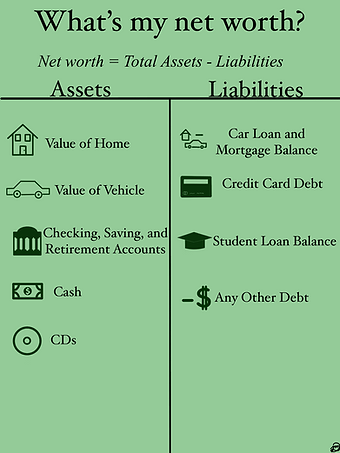
In basketball, the ball is passed rapidly, moving up and down the court and back again. Each team striving to score baskets earning their team points, and then the ball is on the move again. If not for the scoreboard it would be hard to keep track of which team has more points. Tracking your net worth is like your financial score board. Money is always coming in and going out, but if we don’t take the time to track it, it can be hard to know which side is winning- your assets or your debts. 

Your net worth is simply your total wealth minus your debts. Figuring the numbers is as easy as fifth grade math. Add up the value of all your assets and then subtract the balance of your debts. The final number is your net worth. 


One thing to remember is that assets are soft and debts are hard. Meaning that assets go up and down in value, while debts don’t. A debt obligation is always there until it is satisfied, paid off. True, as you pay debts down they do go down, but it remains a cashflow item to service until it is eliminated.


Your net worth is an indication of how you stand financially. Knowing this number helps pinpoint where you are on your financial goal timeline. It can also reveal weaknesses hiding within your spending plan. You need to know if your debts are growing faster than your income is increasing.  If you’re just starting out it might be a good idea to track your net worth quarterly, but as you become more familiar with the process you should be running your numbers at least annually.

It’s quite simple to create a spreadsheet and list everything out, breaking it down into categories like money assets (cash and banking accounts), personal assets or use assets (your car and house), investments (stocks and retirement accounts), and liabilities.  It’s very easy to track your net worth and definitely worth the effort.

It may seem a bit redundant; on the surface our finances might look just fine, but in a world of instant digital spending and special credit cards offered at every store you shop at, it’s easy to feel like you own more than you do. Remember that when something is on credit you don’t really own it until it’s completely paid off, until then it’s a debt. Tracking your net worth helps keep those things in perspective, showing you a truer picture of what you actually own, and what still belongs to the bank.  If you are spending more than you make your net worth will decrease. The best way to increase your net worth is to consistently at the first save a percentage of your income, then pay off debts and other living expenses.


Managing your cashflow and tracking your net worth are two key steps in being in control of your finances. It takes the constantly shifting clutter of numbers and simplifies it to a single number giving you proper perspective. With that information you can make wiser decisions that will lead to the life, and ultimately, the retirement you really want, making you the winner in the game of finances.


Are ESG Investments Really Ethical?

Posted by Wendell Brock on Mon, Dec 12, 2022

Are ESG Investments Really Ethical?

  • Wendell Brock
  • Dec 12, 2022
  • 3 min read

Updated: Feb 1, 2023


Ethical investing gained the spotlight back in the 60’s during the civil rights movement and the boycotting of companies that either supported or were involved with the Vietnam War. People felt the push to align their investments and support companies that shared their personal ethics. Since 2005, we have seen the rise in popularity of ethical investing in the form of ESGs, this time with a broader focus which includes environmental, social, and governance factors, aimed to measure the sustainability of a company. There’s a certain “woke” element to ESGs driven by millennial investors around the world, but do these factors really encapsulate the morality of a company? Does it really help investors align with the companies that hold their same values?

ESGs are scored on factors like how a company effects the natural environment around it, if the company is meeting “green” legislation, how the company treats its employees and customers, if it supports the surrounding community, as well as the company’s diversity, its decision-making procedures, and its policies. In whole, an ESG score looks to grade a company on its direct and indirect effect it has on the wellbeing of others. On the surface, this seems like a great way to summarize how well a company may align with your personal ideals and beliefs. But, there are over 150 providers of ESG scores, with no regulated standard on how to grade a company. How do we know where a company’s ethics truly lie if each of these different providers use a different ideology to grade on? There are many unquantifiable factors involved, how are we to know what goes into the making of a company’s ESG rating?


MSCI, the largest provider of ESG ratings, posted on their website, “ESG ratings focus in on what’s significant to a company’s bottom line and compare it with its peer group.” And “we look at the company’s exposure to industry-specific risks, based on its business activities, size of its operations, and where it operates.”


There are many examples of companies receiving an upgraded score, even when they made no changes just because the ESG provider changed the focus or the way it weighted the score. For example, one fast food restaurant, whose emissions are greater than the whole country of Portugal, received an upgraded score. MSCI changed their grading focus by changing the rating of emissions from 5% to nothing, replacing it instead with an added environmental initiative. This “initiative” was the result of legislation mandating the restaurant to install recycling bins in select locations in Europe. In this situation, it looks like this company is making efforts to minimize its carbon footprint, but in reality its only maintaining the bare minimum requirements and receiving a higher score because of it. This makes it very difficult to analyze what a company’s ethical standing truly is. This is made even more difficult because companies aren’t required to track their ESG performance, allowing them to greenwash their companies and give a false impression.


In an interview done by Bloomberg, MSCI’s CEO was asked if he thinks investors have any idea that the entire system is based on the impact of the world on the company and not the impact of the company on the world, he responded no, he doesn’t think they have any idea. He even went on to say he thinks even investment managers who are putting these funds together don’t grasp it.


Another downside to ESG investing is its limits in diversification. You will have a much smaller pool of stocks to choose from which exposes you to the risks of those unique sectors. Portfolio managers may try to offset the higher risks by adding non-ESG or lower scoring ESG stocks. Many “green” investors may be surprised to find fossil fuel companies included in their ethical ESG mutual funds.


When investing, do your own research. Find the companies that align with your personal ideals.


Tastes Like Savings

Posted by Wendell Brock on Mon, Dec 12, 2022

Tastes Like Savings

  • Wendell Brock
  • Dec 12, 2022
  • 3 min read

The holiday season is upon us, and with it comes holiday shopping, party planning, and Christmas cards, which equals more spending. If you haven’t planned for all the extra spending in your budget and set that money aside your wallet could be in for a real tight squeeze. Let’s go over some money saving tips to help keep the holiday season merry and bright.


It may seem obvious, but the surest way to have more money is to eliminate your debts. One popular method is “snowballing” your debts. Focus on paying more on a single debt, once it’s paid off keep paying that same amount, but apply it to the next debt. By doing this your spending stays the same, but you continue to pay off your debts at an accelerated rate.

Another sure way of saving money is to stop paying for so many things. Cancel any extra or unnecessary subscriptions or services that are cluttering up your budget and sucking up your extra cash. We all enjoy having entertainment, but sometimes it’s easy to take that to extremes in today’s world where there are so many extra things available. Choose the one or two you use the most and cancel the others.


When budgeting time comes, many people are shocked to find out how much they spend on food, especially if you eat out regularly. A quick way to cut down at the grocery store is to stop purchasing the “little extras” like the extra bag of chips, cookies, or the eye catching goodies at the register. Those little purchases add up. When doing your grocery shopping, make a list of items you need (this usually requires a bit of meal planning), and only get the items on your list. Don’t be afraid to use coupons. Just like all those extra little purchases add up, so do the little savings here and there provided by coupons. Money not spent is money saved. There are also apps that will pay you for scanning your receipt. Every little bit helps.


When it comes to eating out, most people know that a restaurant meal costs way more than one cooked at home. One of the most satisfying ways to save money might just be to start cooking at home. While simple in idea, home cooked meals can save you quite a bit! We live in a fast paced world and quick and easy meals have become the norm. However, there is much to be said about a good old fashioned homecooked meal. Not only does it save money, but it brings family and friends together. It helps you take time to enjoy the moment, which brings even more value to those moments.


The average national cost of a chicken dinner at a restaurant is $16.80. To make chicken dinner at home, including 8 oz of chicken, a side of mashed potatoes, and a side of vegetables costs you about $3.20 a serving. If you multiply that by the size of a family of four you’re looking at over $67 (not including a tip or drinks) at a restaurant compared to just under $13 at home. That is a huge savings! If you were to normally eat out once a week, as a family of four for one month, you’d be paying about $335 compared to just $65 for the homecooked meal. That’s a difference of $270 over the course of the month for just one meal a week! Imagine if you ate the majority of your meals at home. The savings would pile up, cooking up quite a savory bottom line.


Try this old fashion chicken dinner recipe!


Ingredients

For the chicken:

4 boneless, skinless chicken breasts

1/2 cup flour

2-3 TBS vegetable shortening or cooking oil

1/2 tsp salt

1/4 tsp pepper

For the mashed potatoes:

2 lbs. Russet potatoes, peeled & cubed

3/4 cup Heavy cream

3 TBS Butter

Salt / pepper to taste

Instructions

Chicken:

Preheat oven to 350 degrees.

Preheat a large skillet on med. high with shortening or oil. In a medium sized bowl mix flour, salt, and pepper.

Cut chicken breasts into similar sized pieces

Dip each piece of chicken into the flour, gently turning until the chicken is completely covered. Carefully place the coated chicken into the hot pan. Brown sides evenly. Transfer chicken to a large baking dish. Add a little water to the bottom of the pan and cover with lid or foil. Bake for about 40 minutes, or until chicken juices run clear.

Mashed potatoes:

Place peeled and cubed potatoes in a large pot. Cover with water, add salt and boil until potatoes are tender, about 15-20 minutes.

Drain the water. Add cream and butter, then mash until potatoes are fluffy and smooth.

Top with butter or your favorite gravy.

Serve meal with your favorite vegetable.

*Chef’s note:

This recipe is easy to customize with different flavors! Try adding some fresh garlic, onions, or other aromatic herbs like rosemary, thyme, or parsley.


Traditional Christmas Cookie Recipe

Posted by Wendell Brock on Mon, Dec 12, 2022

Traditional Christmas Cookie Recipe

  • Wendell Brock
  • Dec 12, 2022
  • 1 min read

Everyone loves cookies at the holidays, well, most everyone. Here's a fun traditional Christmas cookie recipe, just like Grandma used to make!


Traditional Molasses Cookies


Ingredients:

¾ cup butter, softened

1 cup sugar

1 large egg

¼ tsp salt

½ tsp ginger

½ tsp cinnamon

2 tsp baking soda

¼ cup molasses

2 ¼ cups flour

sugar for dipping

Directions:

Preheat oven to 350 degrees f.

Cream butter and sugar together. Add egg and mix until combined. Add spices and molasses and mix thoroughly. Add the flour and mix a final time until everything is well combined.

Spoon dough into balls and roll smooth. Dip the dough ball into the sugar and place on a baking sheet.

Bake about 9-11 minutes (time will vary based on your oven).


Enjoy! And remember to share some with your friends!


120514_WWBrock_1

Wendell W. Brock, MBA, ChFC

Subscribe by Email

Follow Me

Most Popular Posts

Other Sites I Follow, hobbies, fun and info:

gold-vs-silver-1.jpg  Nauvoo Mint brokerage services for precious metals


john Mauldin chair

Note:

Outside Economics is not a registered investment advisory firm (RIA) and does not act as an RIA. Outside Economics does not provide any specific investment advice. Any information obtained from this website or through one of  Outside Economics' representatives should be reviewed by a professional.

Subscribers Note: We do not sell our email list. Period. Thank you for subscribing.

Recent Posts