Outside Economics

Gross Output

Posted by Wendell Brock on Sat, May 25, 2024

Gross Output

  • Wendell Brock
  • May 25, 2024
  • 1 min read

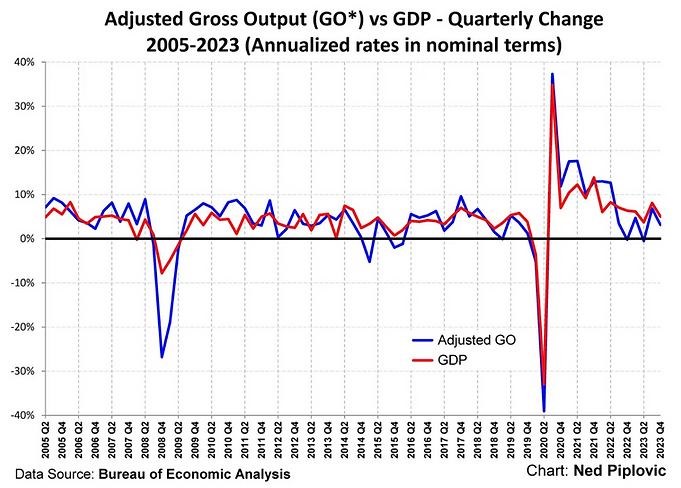
Gross output is used to measure the total economic activity of a business or industry. Where GDP only accounts for the final goods and services provided, GO includes both the final output as well as costs of production. This makes it a more comprehensive measure of economic activity and gives us a broader and more complete picture of the health of the     current economy.


Example: A manufacturer buys leather, rubber for soles, laces, foam insoles, as well as other small items to produce shoes. They also use energy to run their facility and the equipment used to produce their product. The manufacturer pays one employee to help assemble the shoes and another to transport the finished product to customers or retailers. All of these costs are factored into the gross output. In our example, the manufacturer’s gross output is the revenue earned from the selling of their products.


As of March 2024, the U.S. Gross Output has not looked healthy and has trailed the GDP growth rate for the last few quarters. Business spending has shown no real growth since the beginning of 2022. Consumer spending outpaced business spending growth. Unlike consumption, business spending is more volatile and sensitive to economic fluctuations.

The latest GO report showed a rise of 2.4%, which is quite a bit lower than the 3.5% growth from the previous period and trails the 3.4% growth of GDP. In general, when the GO trails the GDP, it usually foreshadows trouble.


The Heartbeat Of Our Country

Posted by Wendell Brock on Wed, May 22, 2024

The Heartbeat Of Our Country

  • Wendell Brock
  • May 22, 2024
  • 2 min read

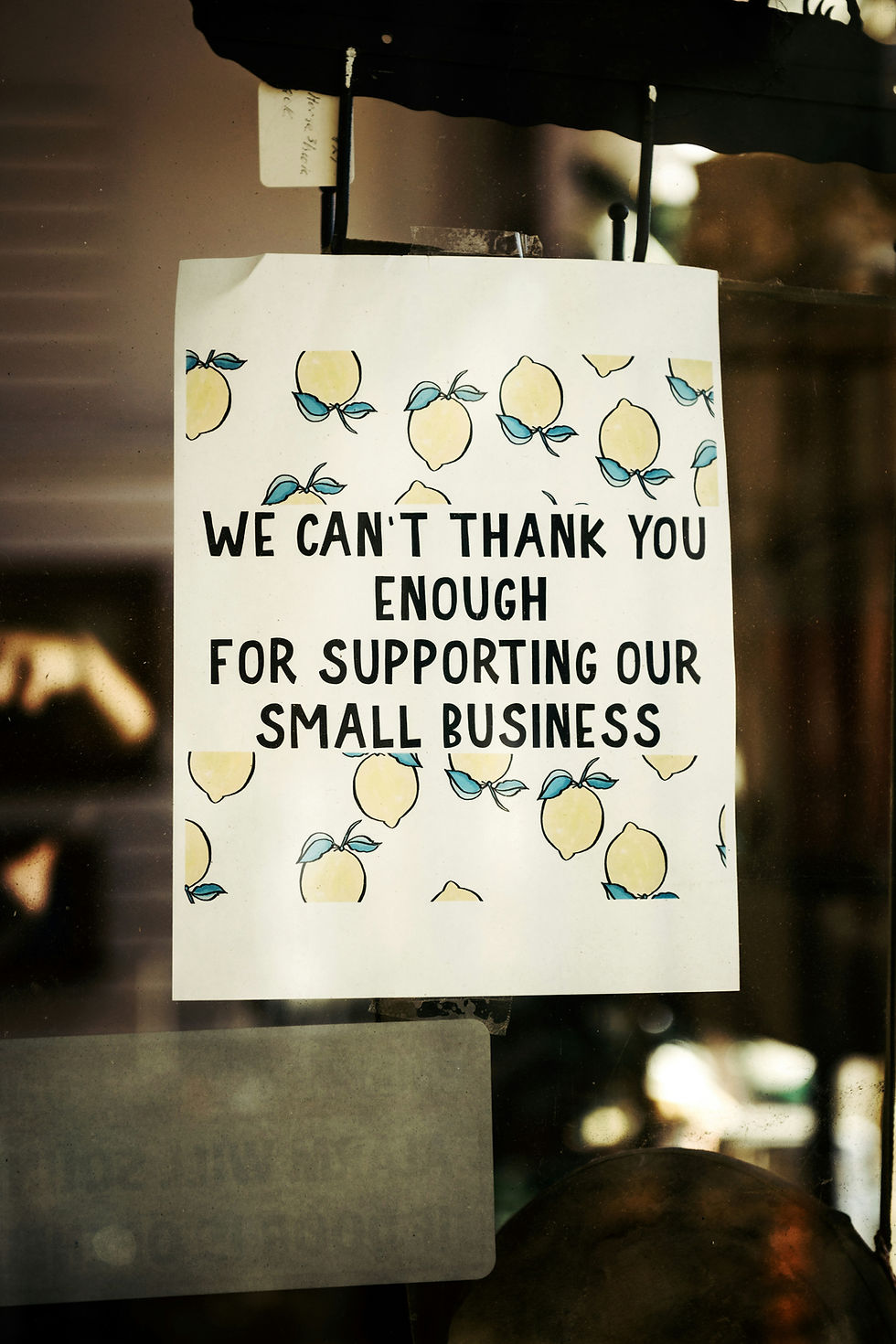
2024 has undoubtedly been a newsworthy year, and we’re only one quarter through! Between the shouts of wars and cries for cease fire, attacks on shipping vessels, thundering earthquakes, the crash and splash of a massive bridge collapsing, the excitement of a solar eclipse, not to mention all the political noise of an election year it can be hard to focus on what’s going on in our country. Through it all, a steady pulse can be felt, the heartbeat of America- Small Businesses. Much like our own human hearts, most people don’t think about the steady thrum of these individual businesses, yet they work on, keeping the body of our economy alive.


According to SBA Office of Advocacy, small businesses have accounted for over 40% of our GDP over the last few decades. They contribute significantly to our local economies, circulating revenue and supporting other local businesses, which is vital to keeping our economy healthy. Small businesses help to stabilize our economy. These enterprises provide employment opportunities within our communities and bring creativity, and more competition to the marketplace. New and innovative ideas often come from small businesses, helping to drive our economy forward. Small businesses help to knit our communities together.


The U.S. Chamber of Commerce reports that there were 12.9 million jobs created by small businesses between 1996 and 2021, an average of 516,000 a year. After the pandemic we saw a surge, 5.5 million jobs created from small businesses from 2020 to now, an average of 1,571,000 jobs a year.


Small businesses face plenty of challenges. They have limited access to capital compared to big corporations, increased pressure from other competitors, regulatory hurdles and red tape to deal with, not to mention the volatility of our current economic situation. Recession and inflation have been a huge obstacle for small businesses. Over 50% of small business owners say that inflation is their top challenge (U.S. Chamber of Commerce 2023).


Without small businesses pumping life into our economy the American people and our economy would experience a tremendous strain, on both a national and local scale. The consequences would reach far beyond the loss of millions of jobs. Small businesses contribute  substantially to our economy, without their contribution economic growth and innovation would slow. We would see reduced consumer spending and investing, which could lead to a recession. We would see supply chain disruptions and kinks in our supply chain which affect  other parts of our economy. We would lose the uniqueness and diversity we gain from having so many different businesses, which would result in a                  concentration of economic power in the hands of larger corporations, reducing competition. Without small businesses the government would lose a substantial amount in tax revenues, which would put pressure on government budgets, potentially leading to cuts in  public services and higher taxes on personal wages. 


It's crucial, more now than ever, to support small business and create a more stable and healthy economy. The importance of small businesses cannot be overstated. When we support small businesses, we ensure that steady life giving pulse will endure, giving life to our country for decades to come.


Photo 2 by: Tim Mossholder



Bringing Back the Blue Collar

Posted by Wendell Brock on Wed, May 15, 2024

Bringing Back the Blue Collar

  • Wendell Brock
  • May 15, 2024
  • 2 min read

We’re seeing a shift in the popularity of collar colors. For years parents and high school councilors have  encouraged young people to pursue traditional college educations and settle into a high paying white-collar job with a white picket fence to go with it. The prioritization of college degrees over trade careers has created an increasing shortage of skilled blue-collar workers in the US. There are over 9 million unfilled blue-collar jobs. So what do we do when the backbone of our economy starts to give out?


There is a demand for skilled trades people, which is outpacing the supply of people qualified to fill those roles. This shortage has increased the demand, which in turn has increased what businesses are willing to pay those workers. Between 2010 and 2012 the wage increase for blue color jobs went up only .6% compared to the increase of 4.5% for white collar jobs. However, between 2020 and 2022 those same blue color jobs increased pay by 14%, where the white-collar jobs only saw an increase of 7.5%. Wage gains for some blue-collar jobs have started to outpace gains for white collar jobs over the last three years. The combined shortage of trade workers and higher pay is driving up costs, creating a domino effect in our economy.


The starting pay for most white-collar jobs is still higher than entry level blue-collar jobs, but under the latest economic stress we’re seeing more and more layoffs in the white-collar world. Companies are turning to AI, replacing many employees as businesses try to cut back and ease the pinching pressure of our struggling economy. The result: many white-collar jobs are not as stable as they used to be.


Eight of the ten highest earning industries for small business ownership come from blue-collar industries including: construction, roofing, flooring, painting, heating & air conditioning, carpentry, plumbing, and electrical- all of which can earn more than $5,000 a month. This challenges the idea that you need to have a four-year degree in order to stand amongst the top earners of the country.


Blue-collar workers have always been the backbone of the United States and play a vital role in the American economy. In order to fuel a healthy economy, we need to find a balance between the blue-collar and the white-collar, this may require a shift in perspective as we help the young and upcoming workforce realize that blue-collar jobs are worth investing their time in. This country was built on the hard work of people willing to get their hands dirty and put in the extra effort.


Photo by: Jason Richard


120514_WWBrock_1

Wendell W. Brock, MBA, ChFC

Subscribe by Email

Follow Me

Most Popular Posts

Other Sites I Follow, hobbies, fun and info:

gold-vs-silver-1.jpg  Nauvoo Mint brokerage services for precious metals


john Mauldin chair

Note:

Outside Economics is not a registered investment advisory firm (RIA) and does not act as an RIA. Outside Economics does not provide any specific investment advice. Any information obtained from this website or through one of  Outside Economics' representatives should be reviewed by a professional.

Subscribers Note: We do not sell our email list. Period. Thank you for subscribing.

Recent Posts