Outside Economics

Money Stress and Your Health

Posted by Wendell Brock on Fri, Jul 22, 2022

Money Stress and Your Health

  • Wendell Brock
  • Jul 22, 2022
  • 2 min read

We all know that chronic stress can have some pretty severe effects on our health, from migraines, stomach aches, ulcers, and insomnia to more severe things including weight gain, depression, strokes, and heart attacks.


Back in December of 2020 CreditWise released a survey showing 73% of participants said worries about finances were their number one cause for stress. This beat out politics, work, and family stressors. In other words, the majority of people agree that money can be stressful! Losing a job, unexpected health problems, emergencies , or compounding debt can all lead to an increase in stress that can affect nearly every aspect of life. If left unchecked, the associated health problems have the potential to lead to high-cost medical bills, which then leads to even more financial stress.


So where does the cycle end? How can we overcome the stress associated with money? The best solution is to avoid unnecessary debt and stick to your budget or spending plan…but things don’t always go according to plan.


If you have encountered money problems, there’s a few things you can do to help alleviate some of your stress and start to work your way out of your financial woes. The first thing is to focus on the things that are within your control, such as sticking to a budget. If you spend your time focusing on the things outside of your control, you’ll only feel more overwhelmed and will lose the power you DO have.
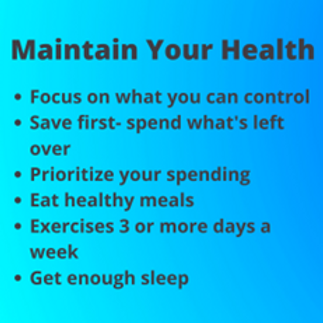


Prioritize your bills and make sure you are paying the essentials first. Often you can talk to creditors and see if they are open to offering temporary solutions such as repayment freezes or not reporting missed payments to credit bureaus.


As soon as you are able, start saving money and then track your money-saving or debt payment progress. Having a visual reference can help keep you positive and focusing on your accomplishments.


If you have taken these steps and still feel like you’re losing ground, don’t be afraid to reach out to a financial advisor. Their experience and insight can help take some of the extra weight off your shoulders as well as developing a plan focused on your specific needs and goals.


It’s important to make your health a priority during times of stress. Stay active and keep your body moving. Exercise is one of the best ways to burn off stress and anxiety. Aim for exercising 3-5 times a week. Eat healthy meals with plenty of vegetables so your body is getting the needed nutrients. Above all, get adequate sleep. Let the worries go for the night and start fresh in the morning. Experts say sleep is the number one key to improving your health. When you get enough sleep, you’re able to think with a clear mind and keep much of the anxiety away.


Money stress doesn’t have to control your life or ruin your health. If you feel yourself becoming overwhelmed with worries about money and finances reflect on the things you can do, both with your money and your health, empower yourself and take action.




Can Money Buy Happiness?

Posted by Wendell Brock on Fri, Jul 08, 2022

Can Money Buy Happiness?

  • Wendell Brock
  • Jul 8, 2022
  • 3 min read

It’s no secret, times are tough. We have seen prices on gas, groceries, utilities, and other products go up, and, up, and up. Money is tight. Families are having to change, not just their spending plans, but their travel and family plans. People are having to say no to things on their wish lists. This certainly isn’t bringing smiles to the masses. In fact, all this may seem depressing and bring on feelings of uncertainty and even fear. It brings to question if the old adage, “Money can’t buy happiness” is wrong. But this isn’t the first time our country has seen tough times, nor is it even close, worldwide. And yet, happiness has prevailed throughout history. So how do those two ideas converge?


If simply acquiring money is your sole ambition, then you will inevitably be disappointed and enjoy little happiness. If you consider money (or the acquisition of it) to be evil or vain, you will be unable to find success in your monetary pursuits. But, if you consider the good things money can do, when you change your focus to what money can be used for, then you will start to see beyond the cold hard cash and find joy in the pursuit of happiness. It is when you become aware of the worthwhile causes and the enriching experiences that we are able to see how money can truly be associated with happiness.

You must be cautions, if you tell yourself you are pursing money and ambition for the sake of others, but you become prideful in that pursuit, you may discover that that path is empty and void of satisfaction. It’s all in your mindset.


So, what is your reason for pursuing or acquiring more money? What do you value? What is the end purpose for your money? If it’s simply to have more money, happiness may elude you, simply because money can only be a means to an end.

Ask yourself what are the most vital things you can acquire; are they temporal, or of a more lasting nature? What lasting value do your possessions have?


Our greatest happiness and fulfillment comes, not from our possessions, but from the relationships we form, the knowledge we gain, and the growth we experience as people. Are you investing as much into your relationships and yourself as you are your 401k?

In 2008 a study was done with a group of college students. Some were given money with instructions to spend it on themselves, others were given money to spend on someone else. They were asked in the beginning which group they thought would increase their levels of happiness more. Most thought it would be the group spending the money on something they wanted. However, they were dead wrong. The study found that, “people experienced happier moods, when they gave more money away-but only if they had a choice about how much to give.” And “thinking about money may propel individuals toward using their financial resources to benefit themselves, but spending money on others can provide a more effective route in increasing one’s own happiness.”


Similar studies have shown that when people give to charities, they tend to be more careful in their own spending, becoming more conscientious of frivolous spending. Givers tend to be more financially successful. Giving to others awakens our emotional connection to those around us and has physiological effects that make us happier and healthier.


If you find yourself feeling down and despaired over our current economy, instead of dwelling on those uncertainties, look outward and find a way to help someone. The results will be compounding. Eventually, we discover that it isn’t how much money we have acquired that brings happiness, but our attitude towards it and what we did with that money to benefit the lives of the people we love; it’s our gratitude, our challenges, and the service we gave.


Picture by Szilvia Basso


Arduous, But Necessary

Posted by Wendell Brock on Fri, Jul 01, 2022

Arduous, But Necessary

  • Wendell Brock
  • Jul 1, 2022
  • 3 min read

A prudent and effective tax strategy during your employment years will most likely need to be modified once you retire. When earned income ceases and income from retirement plans, investments, and Social Security commences, tax liabilities change. The impact of the changes is primarily driven by the assets that we have little tax control over once we reach 72 (70 ½ if you reach 70 ½ before January 1, 2020) which include IRAs, 401k plans, and pensions, which triggers RMDs (Required Minimum Distributions).

Distributions from tax deferred retirement accounts such as an IRA or a 401k are generally taxed at the ordinary tax rate. Distributions from a Roth IRA or Roth 401k are income tax free as long as the account has been opened for at least five years and the account holder is 59.5.

Investment income such as stock dividends and bond interest are taxed differently, especially when they are held outside of a retirement account. Realizing gains on stocks that have been held for one year or more can be taxed at a more favorable rate than the conventional rate. Interest on bonds and gains realized on short-term positions less than one year are taxed at the ordinary rate.

Retirement also introduces us to Social Security which, contrary to popular belief, can be taxed. Eligibility for Social Security benefit payments begins at age 62, but can be postponed until age 70. A key determinant as to when to start receiving Social Security may be contingent on the amount of retirement assets in retirement accounts subject to RMDs. This is where tax strategies can vary dramatically.

Retirees with excessive assets in retirement accounts subject to RMDs and with non-retirement investment income may want to confer with a tax professional to help determine when to take Social Security. Conversely, retirees with minimal assets in retirement accounts and investments may have little concern about paying taxes on their Social Security benefits.


The IRS determines if and how taxes are owed on Social Security by the “provisional income” measure. Provisional income includes gross income, tax-free interest, and 50% of Social Security benefits. If the provisional income is above a certain amount, then a portion of the Social Security income becomes taxable.

One way to potentially lower taxes in retirement is to start taking distributions from tax-deferred accounts before it’s required. Again, once you reach age 59½, you can withdraw funds from those accounts without paying the 10% early withdrawal penalty. The withdrawals are still taxed as ordinary income, but over time they reduce the size of tax deferred accounts, and thus the size of your RMDs. Another reason to access those funds before 72 is that it could help you delay taking your Social Security benefit, which increases in size the later you take it, up to age 70.

Another strategy for reducing the potential tax consequences of RMDs is converting a traditional IRA or 401(k) plan into a Roth IRA before the age of 72. A Roth conversion may make sense when you’re certain you’ll be in a higher bracket when you eventually withdraw the money, which is often the case once RMDs and Social Security are factored in.

Many people may find Social Security IRAs complex and maybe even boring subject to look through, but it is definitely worth your while to study the details and information available and consult with a professional because it will make a big difference in how your income is preserved for your later years.


Photo by Kelly Sikkema


120514_WWBrock_1

Wendell W. Brock, MBA, ChFC

Subscribe by Email

Follow Me

Most Popular Posts

Other Sites I Follow, hobbies, fun and info:

gold-vs-silver-1.jpg  Nauvoo Mint brokerage services for precious metals


john Mauldin chair

Note:

Outside Economics is not a registered investment advisory firm (RIA) and does not act as an RIA. Outside Economics does not provide any specific investment advice. Any information obtained from this website or through one of  Outside Economics' representatives should be reviewed by a professional.

Subscribers Note: We do not sell our email list. Period. Thank you for subscribing.

Recent Posts