
Outside Economics

Accidents Happen

Posted by Wendell Brock on Fri, Apr 29, 2022

Accidents Happen

  • Wendell Brock
  • Apr 29, 2022
  • 4 min read

Updated: May 11, 2022

What is your most important asset? Is it your home? Your car? It’s you and your own ability to work. For most people we don’t think twice about acquiring insurance to cover those other assets, but have you covered your future paycheck?

May is Disability Insurance Awareness month and we couldn’t pass up the opportunity to shine a light on this often-over-looked type of insurance. As mentioned, before we are all familiar with homeowners, auto, life, and medical insurance, aside from those well-known commercials with a duck chasing around the recently injured person and their friend shouting in a voice even our kids can recognize, when was the last time you talked about disability insurance?


Disability insurance protects your income if you become sick or injured, providing a way for you to continue paying your bills and protect future earnings. More than a quarter of the people working today will have some type of disability that prevents them from working at some point in their life, and yet 51 million working Americans don’t have disability coverage. 
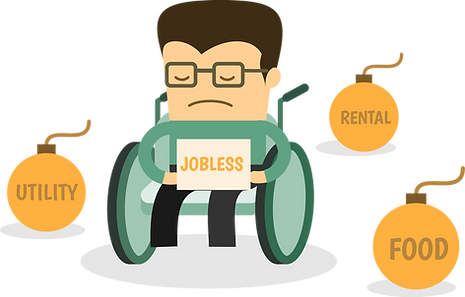


Your financial responsibilities don’t go away if you are unable to work. When looking for a disability plan consider the MUG costs, your Mortgage, Utilities, and Groceries. Using this simple rule-of-thumb, at the very least, the policy amount should be large enough to cover these items.

Many employers provide some sort of disability benefit. Always take advantage of this when you can, however, an employer sponsored plan will not always provide you with lasting coverage, nor can you take it with you if you get a different job. Having your own personal coverage will insure you have what you need regardless of where you work. A personally owned policy is the most secure way to make sure you and your family are covered to some level of income, (ie,. The MUG scenario)

It is very important to understand the details of your coverage, whether through your employment or an individual policy. You need to know how your policy defines “disability”. All companies have a different policy; a new employer might have a different definition within their policy. Social Security defines it as total disability - meaning you can’t work AT ALL, this is a very narrow definition and will affect whether you can receive a benefit if you become disabled.


For private policies the definition ranges from not being able to work at all to a broader view of if you can’t perform your specific occupation. For example, a surgeon that is no longer able to use his hands has to transition to a teaching position - probably making less than he would have as a practicing surgeon. The right disability policy would make up some of the difference between the two salaries.


You also need to know which definition triggers a payment of benefit, as well as if it covers mental disability as well as physical, and if physical coverage includes both injury and illness.


When your employer provides disability, and they are paying the premiums for their employees it becomes a tax-deductible business expense. This makes you responsible for paying taxes on the benefit received. However, if you paid the premiums with after-tax dollars, you may receive the benefits income tax free. Which means, when you receive benefits from your personal disability insurance policy, for tax reporting purposes, it’s not actually classified as income. 


There maybe an elimination period - the length of time between your disability and the payment of benefits. Shorter waiting periods carry a higher premium than the longer elimination periods. This is a prime reason to have an emergency fund. You should plan your emergency fund to coincide with your elimination period, so you are able to cover your “MUG” expenses without going into debt and causing more stress.


You also need to know the length of duration for your policy. The ideal would be a policy that pays until age 65, but for some people that is a long way off and can make for a very expensive policy. Many policies limit the length of coverage to five years. You will need to have a strategy for permanent disability in order to provide income after the five-year period. It’s a good idea to shop around for the policy that works best for you.


Both long term and short-term disability insurance will protect your income and provide a “paycheck” on a regular basis. Each will have a waiting period. The difference comes in the percentage of your overall income that you will receive. Short term coverage will typically cover 60%-70% of your salary for a set amount of time, typically, less than one year. whereas long term coverage will usually provide 40%-60%, for an extended period, either a set number of years or until age 65.

You work hard to afford your everyday living expenses, but life happens, and you may find yourself in a situation you didn’t plan on, perhaps an accident or an illness. May is a good time review this coverage and update as needed.




College Expense Planning

Posted by Wendell Brock on Thu, Apr 28, 2022

College Expense Planning

  • Wendell Brock
  • Apr 28, 2022
  • 2 min read

We’re nearing the time when the school year ends and seniors graduate, eager to start the next stage of their lives. But what does this mean for their parent’s insurance? There are pros and cons for keeping your kids on your family plan. Regardless what direction you choose to go listed below are a few age limits regarding insurance to get you planning for this new phase of life.


Auto Insurance

Kids can stay on their parents' auto insurance even if they have moved out and they’re away at school and still listing the parent’s home address as their primary residence. In addition, children not enrolled in school, considered an eligible dependent (insurers have different definitions), still drive a vehicle owned and insured by a parent, are eligible to stay on their parent's insurance.

If an adult child has a driver's license and is living in at home, then normally your auto insurance company may require that she or he is listed on your policy, regardless of their age.

People living in the same household have access to the insured vehicles, so insurance providers want all licensed household members placed on your car insurance policy. This allows your auto insurance company to look at all drivers' risk factors and calculate car insurance rates accurately.

Health Insurance

Per federal law, a child can remain on their parents' health insurance until their 26th birthday in most states. There are no restrictions before then, so the child is eligible for coverage under their parent's plan even if married, and/or not in school.

Claim As Dependent For Taxes

The Federal Government allows you to claim dependent children until they are 19. This age limit is extended to 24 if they attend college. If your child is over 24 but not earning much income, they can be claimed as a qualifying relative if they meet the income limits and/or if they are permanently disabled. In order to be claimed as a dependent, a child cannot have a gross income of more than $4,300 in tax year 2021 or (2022.Source: IRS)


Debt Is Bondage

Posted by Wendell Brock on Tue, Apr 26, 2022

Debt Is Bondage

  • Wendell Brock
  • Apr 26, 2022
  • 3 min read

These days more and more Americans are finding themselves in debt. Debt is a heavy burden to bare. The more in debt we become the heavier that burden feels. Once in debt the borrower becomes a slave and their debt is bondage. How is it so many people become trapped by debt? Usually it comes down to the interest you incur on that debt.

“Interest never sleeps nor sickens nor dies…it has no love, no sympathy; it is as hard and soulless as a granite cliff…Once in debt, interest is your companion every minute of the day and night; you cannot shun it or slip away form it; you cannot dismiss it. It yields neither to entreaties, demands, or orders; and when you get in its way or cross its course or fail to meet its demands, it crushes you.” -J. Reuban Clark, Jr.

Debt is something that has followed mankind from ancient times to modern day. Countless leaders have advised against the plague of being in debt and the shackles it places on our abilities to progress and do the things we’d like to. Benjamin Franklin counseled, “Think what you do when you run in debt. You give to another power over your liberty.”

Don’t ignore your debts. When you are in debt you become a slave. In essence the debt becomes your task master and it owns you and your commitment until the bill is paid in full. Ignorant or irresponsible borrowers may find themselves ensnared by this financial captivity, struggling desperately to escape its clutches. Debt is inflationary. When you buy on credit you’re really buying at a higher price. This is in part due to rising inflation rates in the economy, but even more so with our own personal inflation rate- the escalating cost of living for our own families. When we purchase things on credit, not only do we pay interest, but we end up purchasing an item far greater than we can afford in the first place. Over time, this contributes to the inflation rates for our individual families. It can seem like a long dark endless tunnel. No one should have to feel helpless in their finances. Remember that little steps, small changes, and dedication is all it takes to start the process of regaining control of your finances. The next step is to stop borrowing and focus on saving. If there is something you want to purchase exercise self-control and set money aside for it.

Keep track of your spending and use a budget. By setting a budget and living within that budget obstacles created by debt will crumble away and the light at the end of the tunnel will begin to shine through. “If there is any one thing that will bring peace and contentment into the human heart and into the family, it is to live within our means,” insurance executive Heber J. Grant once expressed. “And if there is any one thing that is grinding and discouraging and disheartening, it is to have debts and obligations that one cannot meet.”

One way to avoid debt in the first place is to make purchases with cash. By doing so we can put a brake on our spending. People who have the cash or can write a check for the purchase of an item usually end up making much more modest purchases than those who buy on installment credit.

Avoiding debt bondage is a “happiness law.” When we undertake debt it’s often for things on our “want” list. Uncontrolled wants are insatiable. If you allow your wants to preoccupy your mind, you will never be satisfied. You will never find peace of mind, security, or happiness, only bondage and misery, thus we diminish our capacity for “happiness” experiences. Understand that freedom, peace, and contentment come into our hearts when we live within our means. Peace, prosperity, and success come to those who have interest working for them rather than against them. Pay your debt and enjoy the freedom that comes from it.


Russia: Oil Crisis

Posted by Wendell Brock on Wed, Apr 20, 2022

Russia: Oil Crisis

  • Wendell Brock
  • Apr 20, 2022
  • 2 min read

Global geopolitical events have historically affected oil and gasoline prices worldwide as production and supply issues evolve. As the largest oil producer in the world, the Unites States accounts for roughly 20% of total world production. Saudi Arabia accounts for 12% and Russia accounts for 11% of total world production. Even though Russia only produces 11% of total production, it accounts for over 10% of total world oil exports, making it one of the largest exporters of oil and a key global provider.

After their invasion of Ukraine, the imposed sanctions on Russia affects these markets since essential payment methods have been restricted, thus not allowing Russia to fulfill ongoing transactions. The result is a butterfly effect, affecting the rest of the world. The International Energy Agency noted that global oil markets were already tight before the Russian invasion, and commercial inventories have been at their lowest levels since 2014, thus compounding global supply constraints.


According to Eurostat, European countries import about 30% of their petroleum products and about 40% of its natural gas from Russia. The major gas/oil pipelines make their way across Ukraine from Russia to European countries in the western part of Europe. Ukraine has been charging Russia billions to use these pipelines since Ukraine broke free of Russia in the early 1990’s. It’s not just Europe that is feeling the ramifications of current events, we’re experiencing it here in the United States as well.

Even though the U.S. has curbed much of its appetite for oil and gasoline over the past few years, demand among emerging economies has increased. Fossil fuels, including natural gas, petroleum, crude oil, and gasoline still account for roughly 80% of energy consumption worldwide according to the International

Energy Agency. Since oil is a primary energy source, rising oil prices can quickly translate into higher prices in different parts of the economy.

Inflation, as measured by the Consumer Price Index (CPI), is made up of various components, including energy, food, and transportation. These three components represent about 20% of the CPI, all of which are directly affected by oil prices. As a larger portion of consumers’ budgets is spent on these three, the less disposable funds consumers will have to spend on other items.

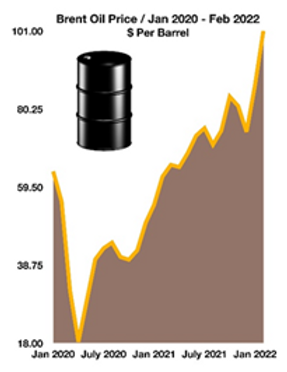
Crude oil is priced in two primary markets, international Brent and as domestic West Texas Intermediate (WTI). Both are priced per barrel and determined by multiple factors, including production, supply, demand, economic growth, weather, and geo-political issues. Unfortunately, Brent and WTI prices had already been rising due to supply constraint issues and increasing demand. The emergence of the Ukrainian conflict has propelled prices even higher, eclipsing $100 per barrel for Brent in February, a level not reached since 2014.


120514_WWBrock_1

Wendell W. Brock, MBA, ChFC

Subscribe by Email

Follow Me

Most Popular Posts

Other Sites I Follow, hobbies, fun and info:

gold-vs-silver-1.jpg  Nauvoo Mint brokerage services for precious metals


john Mauldin chair

Note:

Outside Economics is not a registered investment advisory firm (RIA) and does not act as an RIA. Outside Economics does not provide any specific investment advice. Any information obtained from this website or through one of  Outside Economics' representatives should be reviewed by a professional.

Subscribers Note: We do not sell our email list. Period. Thank you for subscribing.

Recent Posts